
Start With a Colorado Springs Resident Clue
Colorado Springs resident records are split by the key already in hand. An address belongs first with the El Paso County Assessor and the city or county parcel maps. A name may fit the voter match form, a current court docket, a business filing, or a cemetery search. An old address belongs with Pikes Peak Library District directories, newspapers, Sanborn maps, and local archives. The right first source prevents a common mistake: treating an owner, a tax-mailing contact, a voter, or a historical householder as the same thing.
The public trail can confirm that a person or organization is tied to a parcel, case, filing, event, or dated directory entry. It cannot produce a complete household list. Non-owner occupants, protected voters, sealed court parties, and people absent from a particular roll may not appear. A strong Colorado Springs residents directory search keeps the source, date, jurisdiction, and exact name spelling beside every clue.
- Start with the El Paso County property search when the clue is an address, parcel, or owner name.
- Use SpringsView or the county parcel service to confirm the mapped location, ZIP, neighborhood context, and jurisdiction.
- Search the recorder by party role, deed type, date, and legal description when a recorded transfer matters.
- Use Colorado’s voter lookup only for an individual match with the required name, ZIP, and full birthday.
- Move to PPLD, Colorado College, the State Archives, or a custodian request when the question is historical or the online record stops.
Colorado Springs Records Offices
Colorado Springs is the El Paso County seat, but no single office keeps a master residents directory. The Clerk and Recorder indexes deeds and marriage material. The Assessor ties listed owners to parcels. Elections maintains the registration system. Courts hold case files, Public Health holds eligible certificates, and the city clerk routes municipal records under Colorado’s open-records law.
El Paso County Clerk and Recorder
1675 W. Garden of the Gods Road
Colorado Springs, CO 80907
719-520-6200
El Paso County Assessor
1675 W. Garden of the Gods Road, Suite 2300
Colorado Springs, CO 80907
719-520-6600
El Paso County Elections
1675 W. Garden of the Gods Road, Suite 2202
Colorado Springs, CO 80907
719-575-8683
The Colorado Springs City Clerk is the city records custodian at 30 S. Nevada Avenue, Suite 101. It handles city-record and business-license requests, city elections, and CORA routing, but research did not locate a general city resident index. A request should name the department, date range, address, record type, and preferred format.
For county records that are not searchable online, begin with the actual custodian and the Colorado Open Records Act, C.R.S. §§24-72-201 to 206. Criminal-justice material also follows the Colorado Criminal Justice Records Act. The county’s public-records route can explain inspection, copies, exemptions, and redactions.
The City Clerk image shows the city-level fallback, which is useful when the needed record belongs to a municipal department rather than the county roll.
Colorado Springs Assessor Search
The El Paso County Spatialest portal is the best first stop for an address or listed owner. It accepts Schedule or Parcel Number, Address, and Owner Name, with an assessor-neighborhood selector. No login was observed. Results can be sorted by Schedule Number, Address, or Owner Name and shown as a list, grid, or map. The portal caps a result set at 300, so a broad name search needs narrower clues.
The parcel card separates the situs or Location field from Mailing Address. It can show owner, tax status, zoning, plat number, legal description, market and assessed values, land, building details, taxing entities, sales history, deed links, sketches, and images. A mailing address may belong to a trust, bank, attorney, former owner, or out-of-county contact. It is a tax-roll clue, not proof that someone lives at the parcel.
The search fields and visible result families show how an official record is organized:
| Portal field or result | Type | What it contributes |
|---|---|---|
| Schedule / Parcel Number | Text or suggestion | Stable county parcel key |
| Address | Text or suggestion | Situs or location search |
| Owner Name | Text or suggestion | Indexed owner styling, including entities |
| Neighborhood | Select | Assessor data grouping |
| Card links | Result controls | Sales history, recorder, sketch, and image paths |
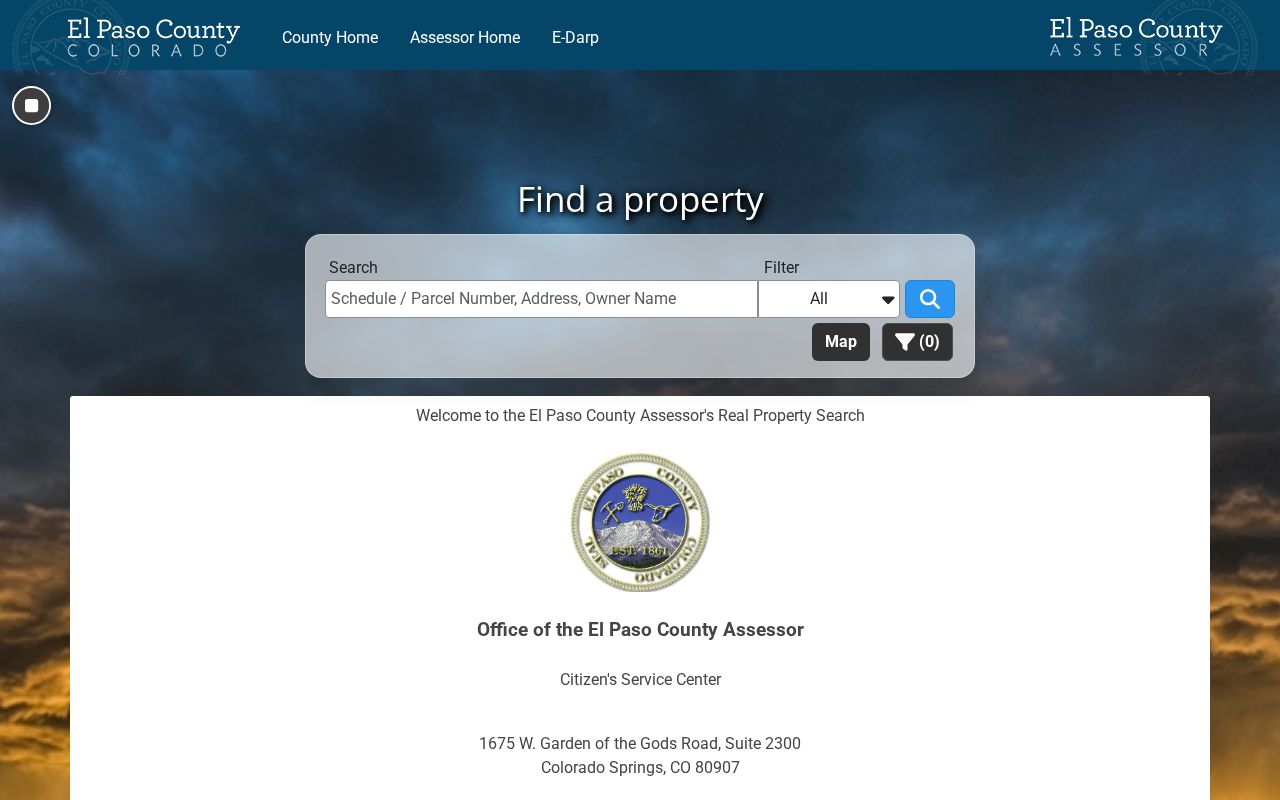
The assessor screenshot places the owner-name, address, and parcel modes in view. Keep those keys with the search date when a result moves to another office.
Map a Colorado Springs Parcel
SpringsView adds a map layer to the assessor clue. Its address geocoder returns a default address, street, city, ZIP, ZIP4, state abbreviation, coordinates, and distance. The city Land Records service contains Address Points, Subaddress Points, Parcel Labels, and Parcels. A parcel result can display Parcel Number, Parcel Address, Owner Name, zoning, legal description, acreage, ZIP, a hyperlink, and geometry.
The county Parcels MapServer is the fallback outside city coverage. Its public identify, query, and find controls return parcel geometry and fields such as PARCEL, HYPERLINK, OBJECTID, area, and length. The county service has a 2,000-record limit; the city layer has a 500-record maximum. Neither is a complete household roster. Match the parcel back to Spatialest before treating a displayed owner as an official assessment record.
The El Paso County parcel service illustrates the geometry step. Click the target polygon, then inspect nearby parcels one at a time rather than inferring a household from visual proximity.
El Paso Deeds and Resident Trails
The El Paso recorder’s real-estate index is keyed to parties and instruments, not to a ready-made street list. Search a current owner as Grantee, choose a date range and a likely deed type, then inspect the seller, legal description, recording date, instrument number, book/page, and image status. Search the seller as a prior grantee and repeat. A grantor can be a seller, trustee, fiduciary, lender, or representative, so party role matters.
The form offers a combined Party Name mode or separate Grantor and Grantee names, role and party-type controls, date fields, instrument ranges, book/page, document type, subdivision, condominium, and section, range, township, or survey fields. Common deed choices include Warranty Deed, Quit Claim Deed, Deed-Other, and Public Trustee Deed. Liens, easements, plats, covenants, releases, and deeds of trust add context but do not all transfer ownership.
The permanent online index begins January 1, 1980, with temporary indexing for the current day. Images were observed from 1980, while routine remote image access is generally 1996 to present and older images are being imported. The index is free to search. The county does not perform a title search for the requester. Copies, especially pre-1996 material, go through the Citizens Service Center and the copy-request route.
The deed-index image shows why a resident trail needs both the party name and the legal description. A similar name with a different lot or role is not enough.
- Parcel
- A mapped piece of land identified by a county number.
- Situs address
- The physical location used to place the parcel, distinct from a tax-mailing address.
- Legal description
- The lot, block, plat, or metes-and-bounds wording that lets older instruments stay tied to the same land.
- Index
- A finding aid for record entries, not necessarily the complete document image.
Colorado Springs Voter Lookup
Colorado’s Go Vote lookup is an individual match form, not a browseable Colorado Springs voter directory. It requires First, Last, ZIP, full Birthday, and reCAPTCHA. The form advises using the name as registered and contacting the county when a match fails. A nonmatch can reflect spelling, an old ZIP, confidential status, age, timing, or a record that is not part of the public match.
Public voter-file fields can include full name, residential address, party affiliation and date, optional phone and gender identity, birth year, and prior-vote information. Social Security number, driver-license number, month and day of birth, signature, and email are confidential. Ballot choice is secret. A statewide or El Paso extract is a separate request, with a different owner, schedule, fee, and field set than the web lookup.
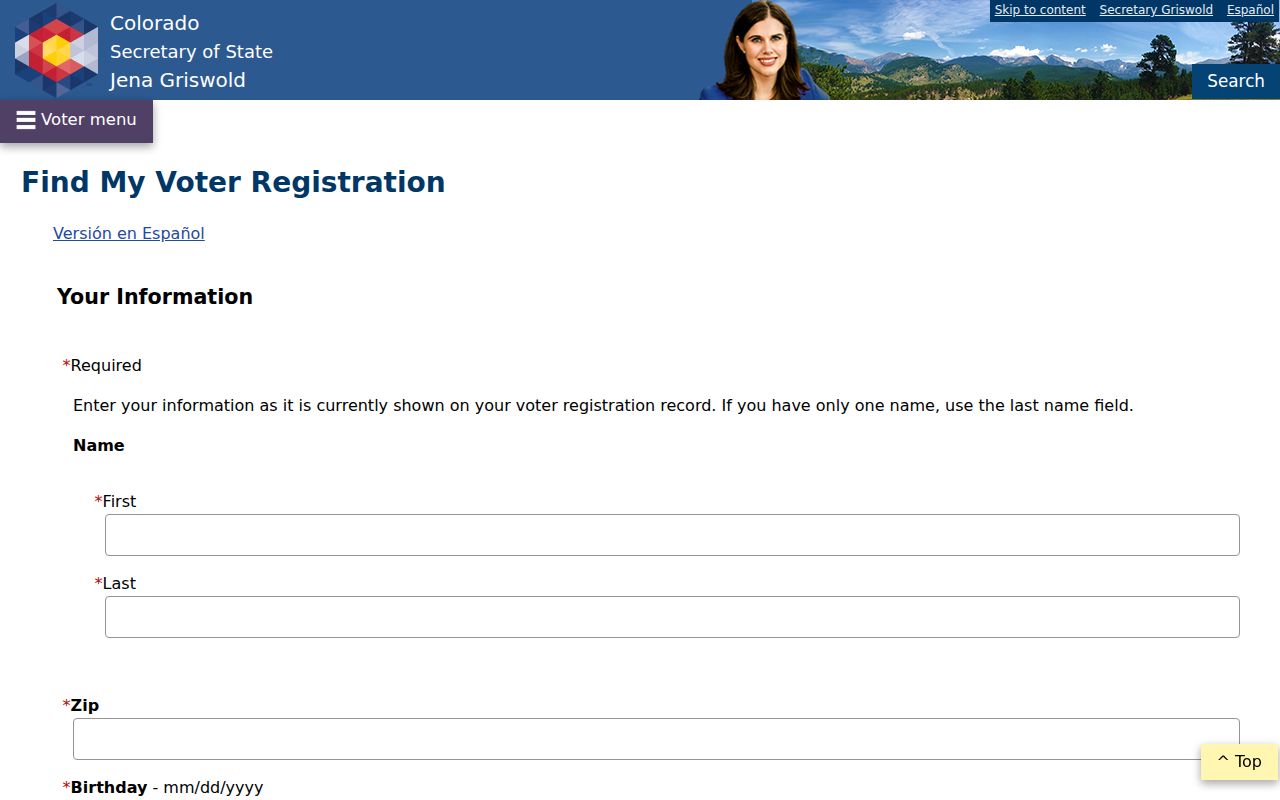
The voter form image makes the required personal-match fields clear. Use it to confirm a specific clue, never as a whole-street browse or a substitute for the assessor.
Colorado Springs Court Docket Clues
The Colorado Judicial Branch Docket Search shows current and future hearing rows for the statewide system, including El Paso County. Filters include district, county, courthouse, court type, division, date range, specific date, four-digit year, case class, case sequence, individual or business party, attorney name, and bar number. A query needs at least one filter beyond the date. Result columns include date, time, duration, name, case number, hearing type, location, appearance type, and courtroom.
A docket row is not a complete case file, disposition, address record, or positive identity match. The Fourth Judicial District handles local district and county files, probate, divorce, and related records. Its S101 records counter and online request route are the fallback for an older filing, while Colorado Springs Municipal Court is separate. Federal cases go through PACER with an account. Restricted, sealed, juvenile, and expunged material may not be available.
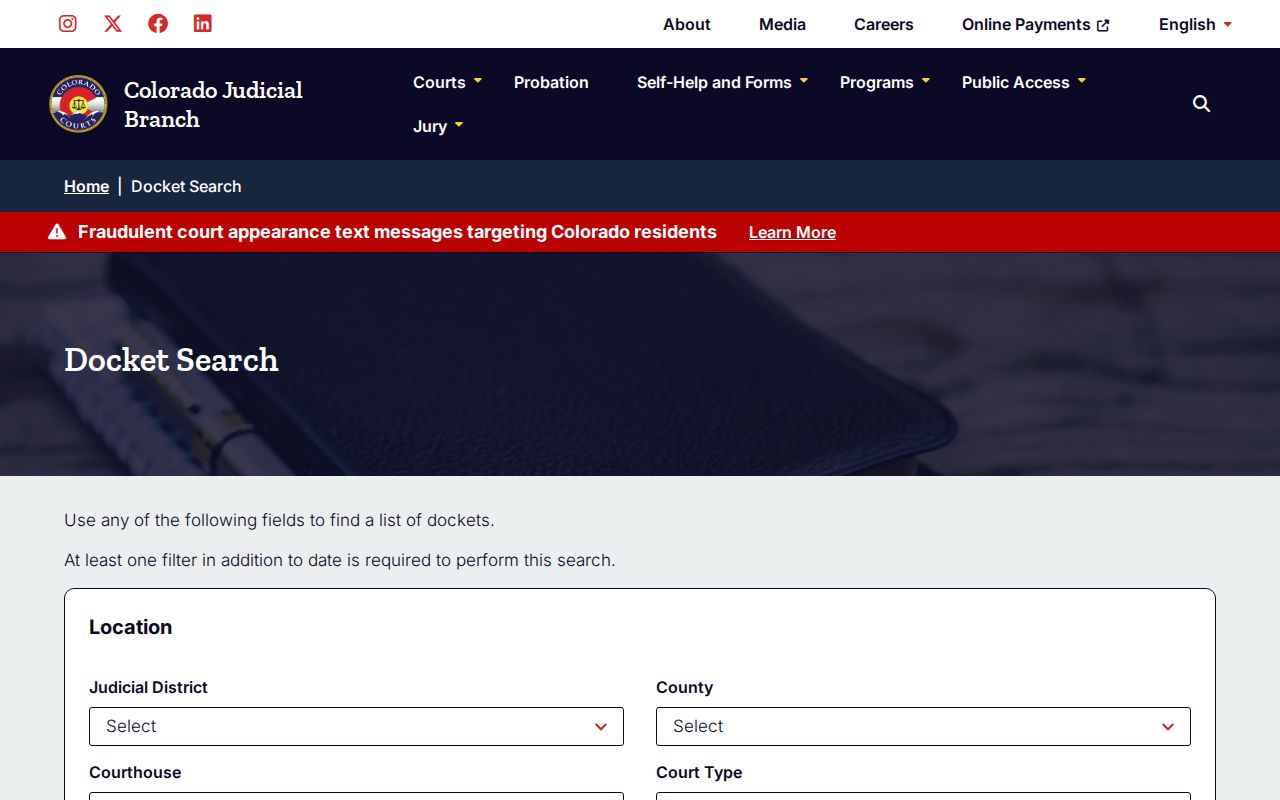
The docket screenshot shows the difference between a hearing index and the file held by the clerk. Preserve the case number and hearing type before requesting a document.
Colorado Springs Vital Records Access
Birth, death, marriage, civil-union, divorce, and adoption records have different custodians. El Paso County Public Health issues certified copies for Colorado births and El Paso County deaths. Its Colorado Springs office lists walk-in windows from 8:00 to 11:50 and 1:00 to 3:50, a lunch closure, a $25 first-copy fee and $20 for each additional copy in one order. Photo identification, eligibility proof, and a nonrefundable fee are required, and digital IDs are not accepted.
CDPHE’s State Registrar handles state-level routing and offers approved online vendors, mail applications, and appointments. C.R.S. §25-2-117 and 5 CCR 1006-1 require identification and direct and tangible interest. There is no general public online name index. The State Archives holds collection-specific historic material, including El Paso death and marriage records, and its birth guidance uses a 100-year access line for records it holds. Divorce and probate access also varies by collection and restriction.
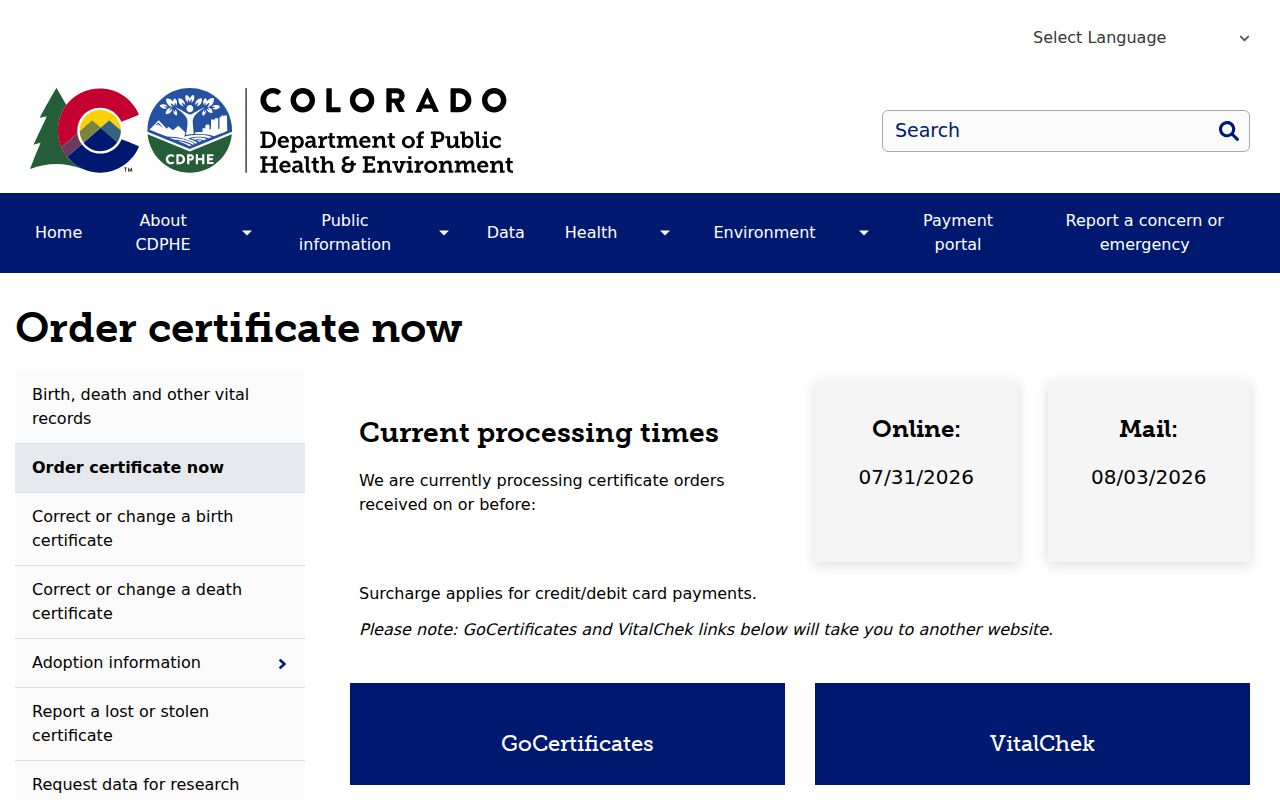
The vital-record application image shows the three-part request path: complete the right form, prove eligibility, and pay the current fee through the named custodian.
Current Colorado Springs Resident Directories
Current records answer different questions. The assessor lists parcel owners and a tax-mailing contact. The voter form checks an individual registration match. The recorder shows parties to recorded instruments. Court, business, cemetery, and unclaimed-property records offer narrower identity or event clues. None is a complete list of everyone at an address.
| Source | What it can confirm | Keeper | Access boundary |
|---|---|---|---|
| Spatialest property roll | Listed owner, parcel, situs, mailing address | El Paso Assessor | Free search; 300-result cap |
| Recorder index | Parties, instruments, dates, legal descriptions | Clerk and Recorder | Free index; image/copy rules apply |
| Voter lookup | Individual registration match and public fields | Colorado SOS and county | Five required match inputs |
| Court docket | Current hearing row and case number | Judicial Branch | Full file through clerk request |
| Business filing | Entity, registered agent, filing history | Colorado SOS | Organizational link, not home proof |
Use the narrowest source that fits the question, then add one independent record. A parcel card plus a recorded instrument is stronger for property history than either alone. A directory entry plus a newspaper or cemetery record is stronger for a past household than a surname alone. The Colorado Springs resident lookup page keeps the one-person verification steps together.
Colorado Springs ZIP Search
ZIP geography is delivery geography. It can cross the Colorado Springs city line, include county-edge growth, or carry a military, PO-box, unique, or special routing function. The city GIS ZIP layer includes spatial values from 80903 through 80951 and also returns nearby or outlying values such as 80132, 80809, 80817, 80819, 80829, 80831, and 80840. A ZIP result should be dated and checked against the current USPS address lookup.
PPRBD accepts a five-digit ZIP in its advanced permit search, SpringsView maps ZIP polygons, and the voter form requires ZIP for a one-person match. The assessor is centered on address, owner, parcel, and neighborhood rather than a normal ZIP-wide search. The Treasurer configuration shows ZIP among fields, but account, name, and address were the active default options. A ZIP narrows a search; it does not prove a person’s address or city residency.
Historical Colorado Springs Resident Directories
The Pikes Peak Library District collection runs from 1879 to the present, with many local volumes from 1879 through 1929 digitized online and gaps between years. The early books cover Colorado Springs, Colorado City, now Old Colorado City, and Manitou Springs. After 1900, many include street cross-references, and the 1904 volume has householders arranged by street alongside historical notes, an alphabetical section, and classified business pages.
The 1904 front matter reports about 14,947 Colorado Springs names or entries. That is a count of directory entries, not a population estimate. The PPLD Regional History and Genealogy room is in the historic 1905 Carnegie building. Walk-ins can use ordinary material; archival pulls can be arranged through 719-531-6333 ext. 7252 or RegionalHistoryGenealogy@ppld.org during posted Wednesday through Saturday research hours.
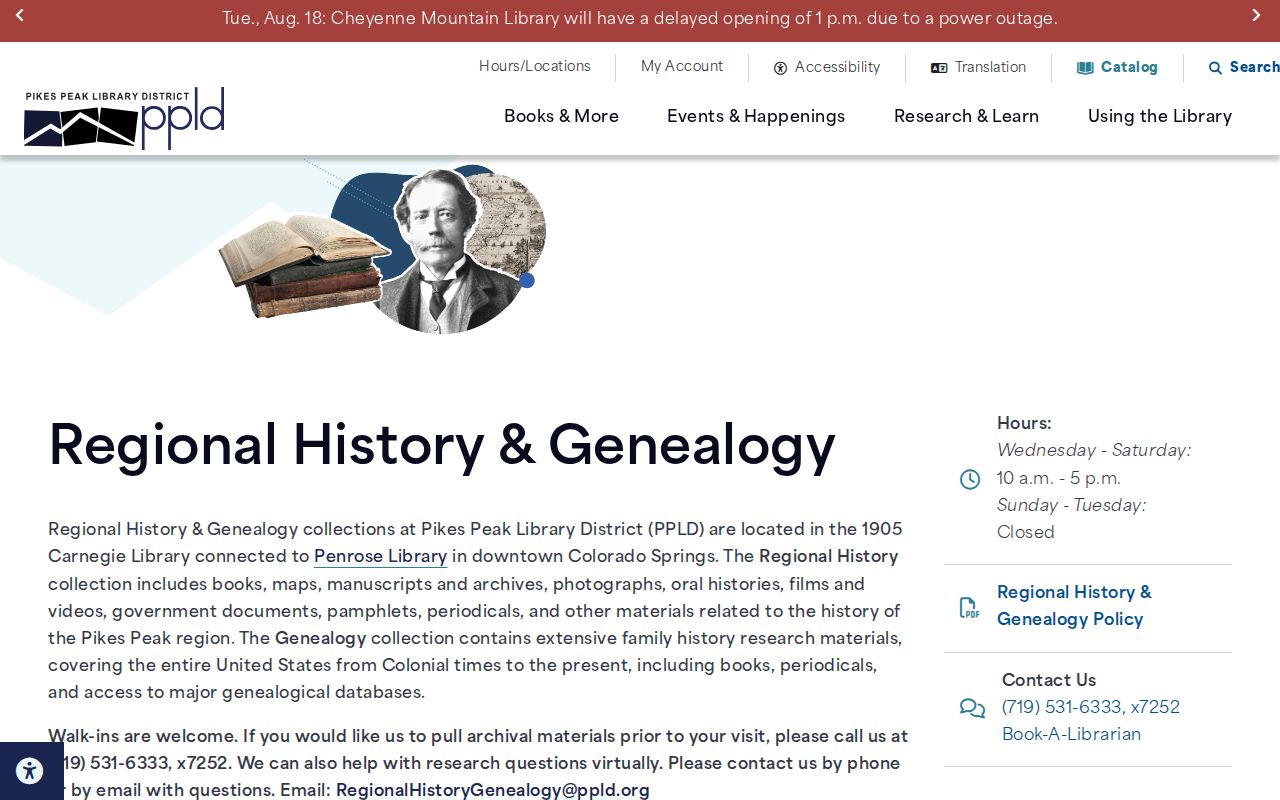
The library image points to the shelf and staff route behind the digitized pages. Read an entry as a dated snapshot, then check the street guide, an adjacent year, and an independent source.
The local record story is unusually concrete. The 1903 El Paso County Courthouse once held four courtrooms and offices for the Sheriff, Treasurer, Clerk, and Surveyor. A preservation campaign saved it after demolition support in 1966, and the building became the Colorado Springs Pioneers Museum in 1979. Its present archives carry maps, blueprints, photographs, manuscripts, and finding aids that can extend a residents directory search beyond a name field.
Colorado Springs Permits and Filings
PPRBD permit and archived-card searches add a dated address trail. The advanced form can search by address, parcel, permit number, plan tracking number, or conveyance identifier, then narrow by jurisdiction, project type, issued-date range, status, discipline, project description, and valuation. It covers Colorado Springs and other participating jurisdictions. Search is free, while some plan images use an account or subscription route. A permit applicant or contractor is a project contact, not automatically a resident.
The Colorado Secretary of State business search adds a different kind of name clue. Its basic form accepts business name, trademark, trade name, ID, or document number. Advanced fields include filing dates, exact match, registered-agent and registrant roles, organization name, and person name components. A principal office or registered agent ties a person to an organization, not necessarily to a private home.
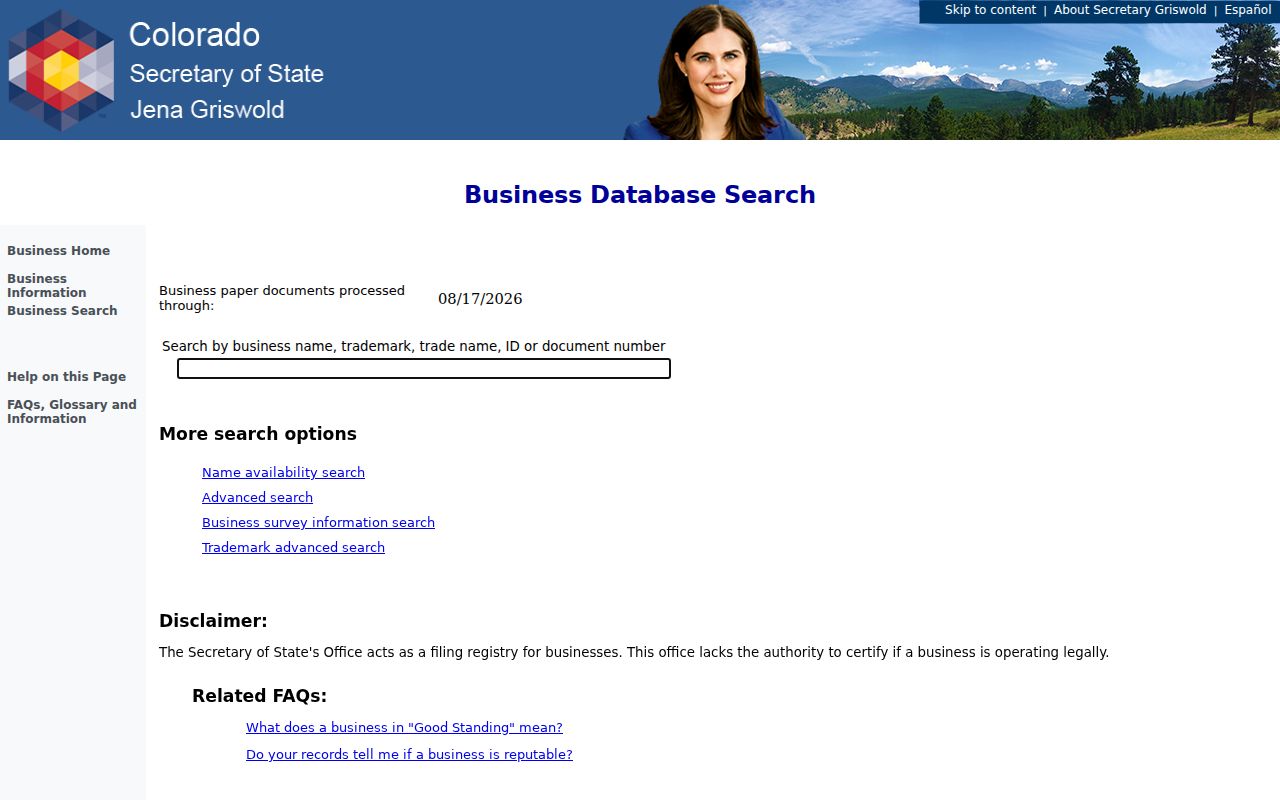
The business-search image shows an affiliation route that can confirm an entity or filing history when a property record is held by a company.
Colorado’s unclaimed-property application is another narrow clue. It accepts a required last name with optional first name, city, ZIP, or property ID. A claim still requires proof of ownership and identity. It can support a family-history or former-address inquiry, but it does not establish current location.
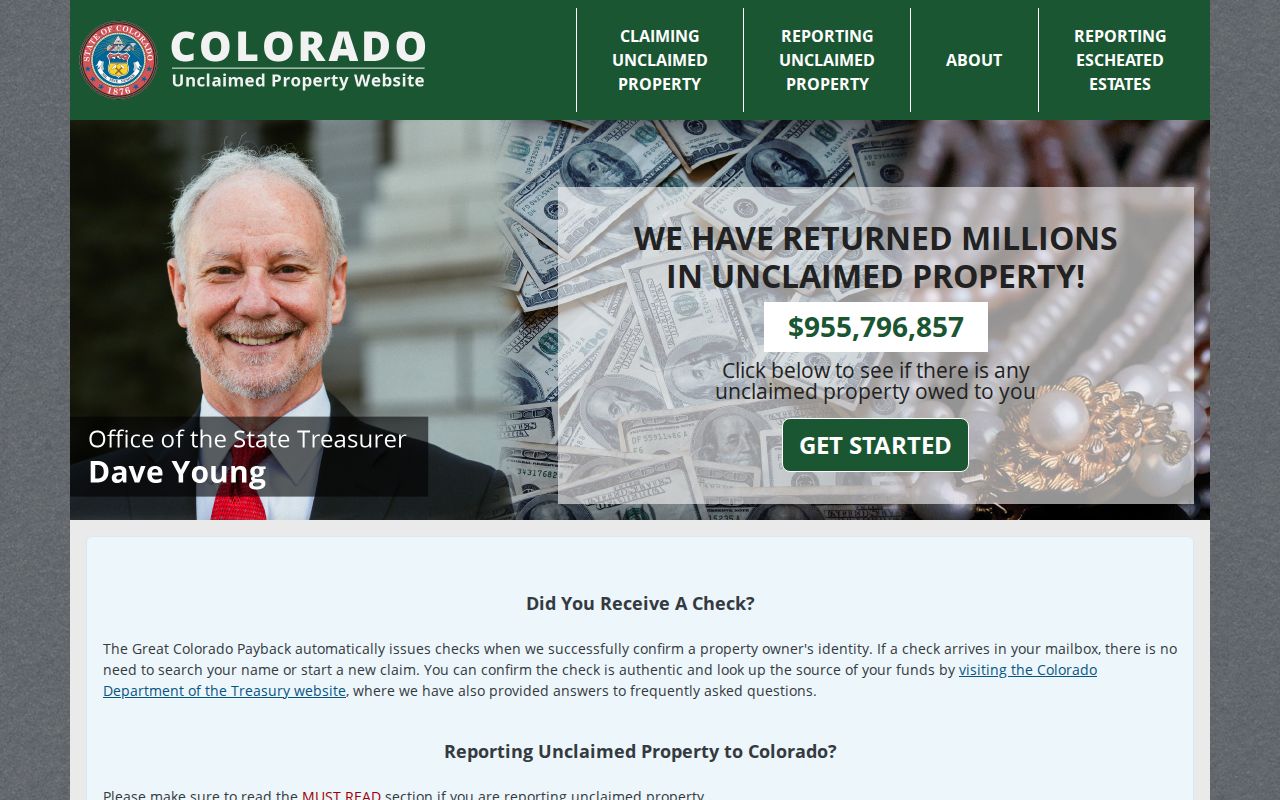
The unclaimed-property image is a reminder that a result belongs to a specific state-held property record, not a general residents directory.
Privacy in the Colorado Springs Residents Directory
Colorado public records have limits. A voter may use the Address Confidentiality Program, commonly called Safe at Home, or request county voter confidentiality for a $5 fee. ACP participants have actual address, county, and precinct information masked. Vital records require direct and tangible interest. Courts can restrict juvenile, adoption, sealed, expunged, and protected-party material. DMV and utility customer addresses are not general public search fields.
Use official records for family history, property curiosity, civic research, reconnecting, estate work, and personal safety awareness. Keep full birthdays, signatures, driver-license numbers, Social Security numbers, emails, and protected addresses out of any notes or publication. If a record is wrong, contact the custodian with the case, parcel, instrument, or certificate reference and ask what correction or redaction process applies.
| Source type | Strength | Limit to keep in mind |
|---|---|---|
| County and state rolls | Named custodian and stated fields | Coverage, confidentiality, and update dates vary |
| Commercial search tools | May combine public and marketing clues | Uneven updates and merged same-name records |
| Library and archive collections | Rich historical context and human help | Gaps, appointments, and dated snapshots |
Lawful use. Public availability is not permission to monitor, threaten, stalk, or harass anyone. Colorado’s stalking and harassment laws, including C.R.S. §§18-3-602 and 18-9-111, apply to misuse of personal information.