
What a Colorado Springs Resident Lookup Can Establish
Start a name check by asking what you actually want to prove. An owner search is a property clue. A voter match tests one registration combination. A court docket pins down a hearing row, and a vital record confirms an event only if you meet Colorado eligibility rules. Business and license filings show a professional or organizational tie. They do not reveal a private home. That distinction matters in El Paso County. Colorado Springs is the county seat, yet the same public systems also serve military installations, neighboring municipalities, and unincorporated areas, so a hit may point somewhere you did not expect.
| Record | What It Confirms | Where | Access |
|---|---|---|---|
| Property roll | Owner styling, mailing address, situs, parcel and building clues | El Paso County Spatialest | Free, no login; results capped at 300 |
| Voter registration | A first name, last name, ZIP, and birthday match | Colorado voter lookup | Free individual match; reCAPTCHA and protected-field limits |
| Court docket | Current hearing, party name, case number, and courtroom clues | Colorado Judicial Branch Docket Search | Current docket view; fuller files require the court |
| Vital record | Eligible birth, death, marriage, divorce, or adoption information | CDPHE order routes | Confidential; ID, eligibility, and a fee apply |
| Business or license filing | Entity, registered-agent, trade-name, or credential context | Colorado SOS and DORA | Public searches, with field and privacy limits |
Choose the first source by the strongest clue. An address points to Spatialest and a parcel map. A case number or hearing date points to the docket. A family event points to the proper vital custodian, while an organization name points to the Secretary of State. The result is a set of independent checks, not a single official household list.
Use Two Anchors in a Colorado Springs Resident Lookup
A name alone carries little weight in a large county. Anchor it to something. Pair a name with an exact street or ZIP, a parcel with its indexed legal name, a person with an entity, or a historical address with a year. And preserve every spelling exactly as written. Initials, middle names, suffixes, married or maiden names, trust names, estate names, and abbreviations can reorder results without changing the person behind them. Spelling is a quiet variable in any lookup.
- Name plus exact street or ZIP
- Name plus business or trade name
- Parcel plus recorded legal name
- Directory address plus year
- Family relationship plus event date
Reject a common-name hit lacking a second clue. The assessor's owner field may hold a trust. It may also hold an estate, a corporation, or a tax-mailing contact. A recorder party could be the seller, trustee, lender, or fiduciary. A court party might be a business. None of those is the person you want. Escape the same-name trap by keeping the jurisdiction beside every name. Keep the date range, address, case class, and source role there too.
Name → address or ZIP → parcel or voter match → court, vital, business, or historical check
Reading the Colorado Springs Assessor Match
With an address or owner name in hand, the El Paso County Assessor Spatialest search is the natural first property check. Three search modes are offered. You can query by Schedule or Parcel Number, by Address, or by Owner Name. Results sort by schedule number, address, or owner name, and display as a list, a grid, or a map. The search is free. No login is needed. One limit: results stop at 300. Before moving on, save the exact owner spelling and situs entry for the next record.
| Owner | The name or entity shown on the property card. |
|---|---|
| Mailing Address | The tax-roll contact address, which is not proof of residence. |
| Location or situs | The parcel location used to tie the record to a place. |
| Tax and zoning | Tax status, zoning, and related parcel context as displayed. |
| Plat and legal | Plat or legal-description clues for a recorder search. |
| Values and building | Value, area, year-built, room, garage, or other building fields when shown. |
| Sales, deed, and sketch | Sales, deed, and sketch links shown on the card. |
The mailing address can be a tax contact. The building field describes the parcel. It says nothing about everyone who uses it. For a recorded transfer, carry the legal description or the exact owner spelling to the recorder. There, separate a deed from a lien, release, covenant, or similar instrument. The county will not do a title search. If the question widens from one person to every address along a road, the Colorado Springs street directory keeps that address-first work in its lane.
El Paso County Assessor
1675 W Garden of Gods Rd, Suite 2300
Colorado Springs, CO 80907
719-520-6600
asrweb@elpasoco.com
Use the card as a clue
Owner, mailing, situs, parcel, legal, value, building, and sales fields can guide the next source. None alone proves current occupancy.
Colorado Springs Resident Record Search Fields
The Colorado Judicial Branch Docket Search is a statewide current-docket tool. Choose El Paso County or the El Paso County Judicial Building when the local court is the target. At least one filter besides the date is required. The fields narrow a name well enough. It is no full historical party index, though.
| Field | Control | Options or format |
|---|---|---|
| District and County | Dropdowns | 1st through 23rd Judicial District; all counties with El Paso selectable |
| Courthouse and Division | Dropdown and text | Local courthouse choices; free-text division |
| Court Type | Choice | Both, County, or District |
| Date Range | Dropdown | 6 Months, 3 Months, 1 Month, 1 Week, Today, or Specific Date |
| Specific Date and Year | Date and text | Specific Date appears when selected; four-digit year for a case-number search |
| Case Class and Sequence | Dropdown and text | C, CR, CV, CW, DR, JD, JV, M, PR, R, S, T; sequence uses 1 to 6 digits |
| Party | Choice and text | Individual or Business; individual first and last name, or business name |
| Attorney | Text and number | Attorney first and last name, or a bar number of 1 to 6 digits |
| Buttons | Actions | Find Dockets and Clear Results |
A result row can carry date, time, duration, name, case number, hearing type, location, appearance type, and courtroom. One August 18, 2026 row shows the pattern. It listed UPSTART NETWORK INC, case 2026C32479, at 8:00 a.m. for one hour: a PreTrial Conference in El Paso County, no appearance required, courtroom CVL. That is a hearing clue. It is not a disposition. It carries no address, birthday, or document image. Results also come with count and pagination controls plus Export Results and Printable Version options.
For older filings, follow the Fourth Judicial District process instead of reading a current docket as the whole case. The record and document request form takes a case number when known, party names, case class, filing or hearing range, the document wanted, and a delivery choice. The courthouse sits at 270 S Tejon. Call 719-452-5000 for the main line, 719-452-5490 for research, and 719-452-5940 for records. Research requests can go to 04ResearchRequest@judicial.state.co.us. Public-access terminals may reach further back than the current web view. The S101 counter is staffed Monday through Friday, 7:30 to 4:30. Colorado Springs Municipal Court is separate. Federal cases require a PACER account.
Local court path
Fourth Judicial District record and document request form
270 S Tejon, Colorado Springs
What to preserve
Case number, party type, hearing date, hearing type, location, appearance type, and courtroom.
Do not stretch a docket name into proof of identity. Juvenile, adoption, sealed, expunged, victim-identifying, and confidential family material may be restricted or redacted. A suspected error belongs with the clerk and case number.
The Colorado Judicial Branch docket search displays the current filters used for a Colorado Springs name check.
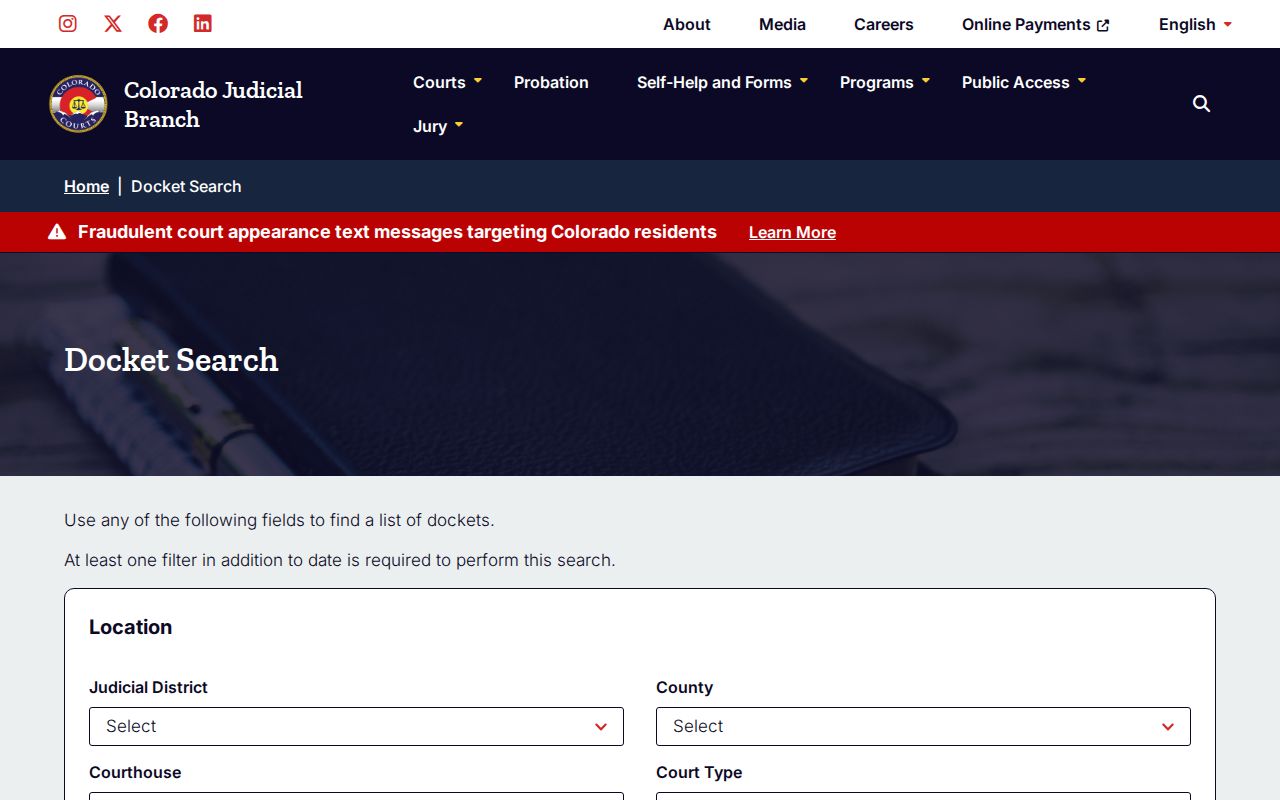
The screen is useful for narrowing a hearing search, while the clerk remains the source for a fuller file.
Colorado Springs Voter Search Record
The Colorado Secretary of State runs a voter form built for one-at-a-time matching. You enter a first name, last name, ZIP, and full birthday, then clear a reCAPTCHA. There is no way to browse by street. A miss can mean many things. A spelling slip, the wrong ZIP or birthday, a protected voter, or a record the public form simply does not serve. A hit shows registration consistency and nothing more. It never proves someone lives at a parcel today.
The official Colorado voter registration lookup shows the fields required for a Colorado Springs name check.
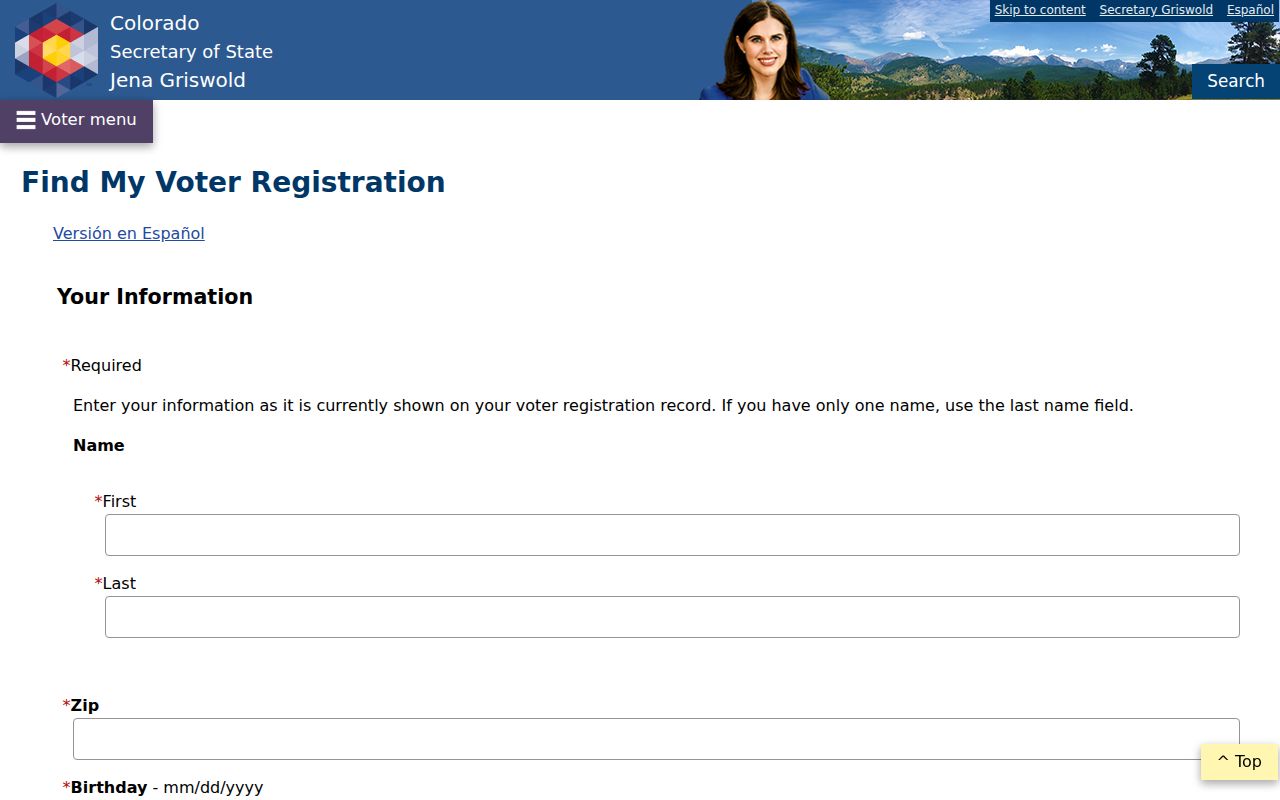
The form's inputs explain why a name-only search cannot reproduce a public voter match.
The public voter file carries more than the web form shows. Fields can include full name and residential address. Party affiliation and its date can appear too. So can optional phone, gender identity, birth year, and past-vote history. SSN, driver-license number, month and day of birth, signature, and email stay confidential. A voter facing criminal harassment or bodily harm can ask the county for confidentiality for a $5 fee. Address Confidentiality Program members get a substitute address instead. The real address, county, and precinct stay masked away.
The bulk route works differently. The 2025-26 request form wants requestor contact details and a report or subscription choice. It also wants a date, signature, amount, and a check or money order. Listed cycle figures run $1,000 for a subscription and $50 for a report disc. A 72-hour first-class target applies depending on the request. El Paso Elections sits at 1675 W Garden of Gods Rd, Suite 2202. It is reachable at 719-575-8683 and elections@elpasoco.com. A bulk file grants no publishing rights. It is not permission to expose protected fields or guess at a whole household.
El Paso Elections
County elections office and voter resources
1675 W Garden of Gods Rd, Suite 2202
719-575-8683
elections@elpasoco.com
Bulk data route
Colorado SOS elections data request form
Separate request, payment, and data-use process.
Verifying a Colorado Springs Resident
Verification means testing a name against records made for other purposes. Begin with the least sensitive, most direct clue. Alongside each result, keep the exact source, search date, jurisdiction, spelling, and the person's role. When two records clash, never blend the fields into one guess. Ask the custodian which field stands as current. Also ask whether a correction or copy request exists.
- Anchor the name. Use a known address, ZIP, business, date, or family relationship. In Spatialest, save the owner styling, location or situs, parcel, and mailing address as separate fields.
- Run the right match. Use the voter form only with the required first name, last name, ZIP, and full birthday. Treat a successful result as registration consistency, not an occupancy finding.
- Check a case clue. Search the docket by party type, name, case class, number, or date when a hearing matters. Preserve the case number and hearing type rather than copying only the name.
- Confirm the event. Use a qualifying vital-record route, a recorded instrument, a business filing, or an independent historical source. Order a certified copy only when the custodian accepts the request and proof of eligibility.
- Record the boundary. Keep owner, tax-mailing contact, voter registrant, court party, registered agent, and occupant distinct. Do not publish full birthdays, signatures, protected addresses, SSNs, or driver-license numbers.
A two-source result carries weight when one source is current. The other source should be independent. An old directory entry can back a classmate or family lead. It should not be passed off as a current address. A deed proves a transfer occurred. It says nothing about where the seller landed next. What you want is a supported identity clue with a clear limit stated.
- Docket
- A court calendar or hearing record. It can show a party and case details without being the full case file or final outcome.
- Index versus image
- An index is a searchable description of a record. An image is the scanned instrument or filing, and access may require a subscription, copy request, or eligibility.
- Certified copy
- A copy issued by the record custodian with a certification statement. It is different from a screen result or an unofficial scan.
Colorado Springs Vital Records for a Resident
Colorado treats vital records as confidential, not as an open public name index. Certified copies of every Colorado birth come from El Paso County Public Health. Deaths occurring in El Paso County come from the same office. The office sits at 1675 W Garden of the Gods Rd, Suite 2044, at 719-575-8492. Walk-ins run first-come from 8:00 to 11:50 and 1:00 to 3:50. Lunch closes the office from 11:50 to 1:00. Bring an application, physical photo ID, proof of relationship or eligibility, and a nonrefundable fee. Digital IDs are not accepted. The fee runs $25 for the first copy. Each added copy in one order runs $20.
The CDPHE vital-record application route shows online, mail, and appointment options used in a Colorado Springs records check.
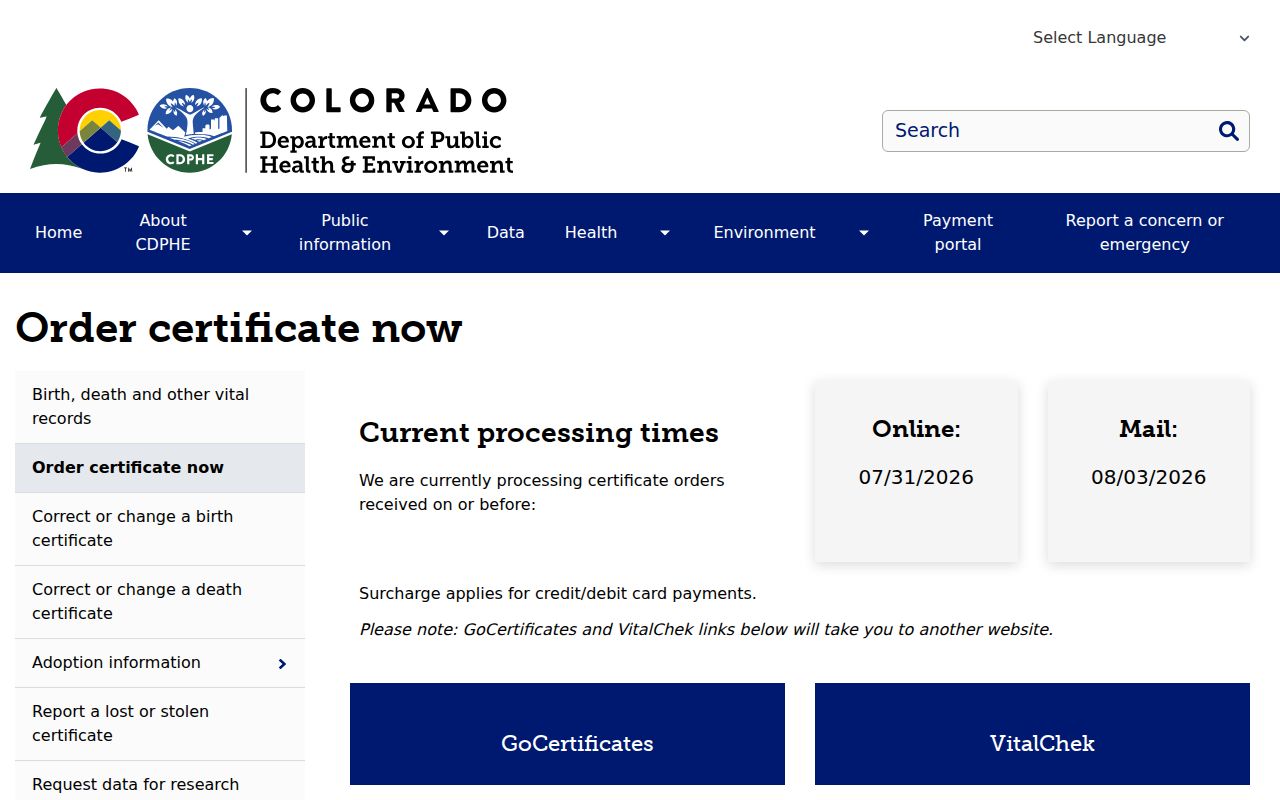
The application path requires the request to fit the record type and the requester's eligibility.
CDPHE handles the state-level side: birth, death, marriage, civil-union, adoption, and divorce records, through online ordering, mail, and an appointment-only counter. C.R.S. section 25-2-117 and 5 CCR 1006-1 keep Colorado vital records confidential. Access turns on direct and tangible interest, identification, and supporting proof. Marriage licenses live with the county Clerk and Recorder. A divorce decree is a district-court file, while CDPHE offers only a verification. Those paths stay separate.
Older material points to the Colorado State Archives. Historic births in its care generally open at 100 years, and divorce guidance applies a 100-year restriction with a narrow decree exception. Its El Paso probate holdings cover 1922-1976, and marriage holdings include fragments from the 1860s through 1932. Before requesting anything, check the State Archives record guides for the collection, age rule, and custodian.
An adoption-related birth-family search runs through a different door. Use the Colorado Voluntary Adoption Registry and the confidential-intermediary route. It serves adult adoptees, siblings or half-siblings, and birth parents who meet the consent rules. A routine birth-certificate request is not an adoption search.
El Paso Public Health
Birth and death records
1675 W Garden of the Gods Rd, Suite 2044
719-575-8492
Access boundary
No general public vital name index. Use the county, CDPHE, court, or Archives route that matches the event and eligibility.
Heir and Classmate Resident Trails in Colorado Springs
An heir search in Colorado Springs begins with probate at the Fourth Judicial District. Older El Paso files go to the State Archives. Probate can name an executor, heirs, property, and legal representatives. The named indexes are incomplete, though. Guardianship, conservatorship, and minor files stay restricted. When you request a case, give the party name, the case number if known, a date range, and the exact document you want. A probate result is a legal relationship clue. It is not permission to publish private family details.
A former classmate takes a different path. The Pikes Peak Library District Regional History and Genealogy collection links a name to a year or an old address, as do Colorado College yearbooks and special collections, local newspapers, city directories, and cemetery records. None of these form a complete public alumni directory. Follow a directory or yearbook lead, then confirm it with a separate newspaper, cemetery, court, business, or eligible vital record. When the trail turns backward, the Colorado Springs city directory page carries the historical collection route.
The PPLD house-history guide points to street guides, directory volumes, newspapers, permits, maps, Sanborn material, and water-tap clues. Its dating advice matters. Colorado Springs, Colorado City, and Manitou Springs appear together in older volumes, and Old Colorado City and Westside street names and odd or even numbering shifted between the 1870s and 1917. Date every result. A 1904 address cannot be assumed to match today's number without a crosswalk.
Colorado Springs Business Record Clues
Businesses hide people in plain sight. A company tie calls for an organization record, not a home-address assumption. The free Colorado Secretary of State business search accepts a business name, trademark, trade name, ID, or document number. The advanced route goes further. It adds filing-date ranges, exact-match choices, registered-agent and registrant searches, and person fields for last name, first name, middle initial, and suffix. Results can show entity ID and status, formation or periodic-report dates, principal office, registered agent, trade name, and filing history.
Open the filing before calling anyone an owner, officer, or organizer. Read the filing history too. A registered agent is an organizational contact. So is a principal office. Neither one is necessarily a personal residence. County recorded instruments can add a local legal connection, but the state entity filing remains the stronger statewide business key. The City publishes no complete public business-license name search. For a local license question, the City Clerk is the right custodian to ask.
Colorado's Division of Professions and Occupations is the official route for a professional license verification. The live lookup can be unreachable. Exact fields, coverage, and result labels vary, so verify the license directly rather than expecting a particular field. This keeps a credential clue separate from a person search. It also avoids filling a gap with guesswork.
Legal Limits on a Colorado Springs Resident Lookup
Public access has limits. The Colorado Privacy Act gives people rights to know, access, correct, delete, and obtain a portable copy of covered commercial data. It honors Global Privacy Control for certain opt-outs. The Colorado Attorney General's Colorado Privacy Act resources also describe exclusions. The law is not a universal deletion button. It does not wipe out an assessor, recorder, court, voter, or vital record. The custodian's own public-record, election, court, property, or health rule controls.
Voter confidentiality can mask a protected address, county, and precinct. The Address Confidentiality Program uses a substitute address. Vital records stay confidential under the cited state statute. Courts may restrict juvenile, adoption, sealed, expunged, protected-party, or sensitive family material. The federal Driver's Privacy Protection Act restricts DMV personal information. A public parcel or voter record does not authorize a DMV lookup.
The Colorado Bureau of Investigation registry search is a bounded snapshot source with its own agreement, incomplete-data warning, and anti-harassment warning.
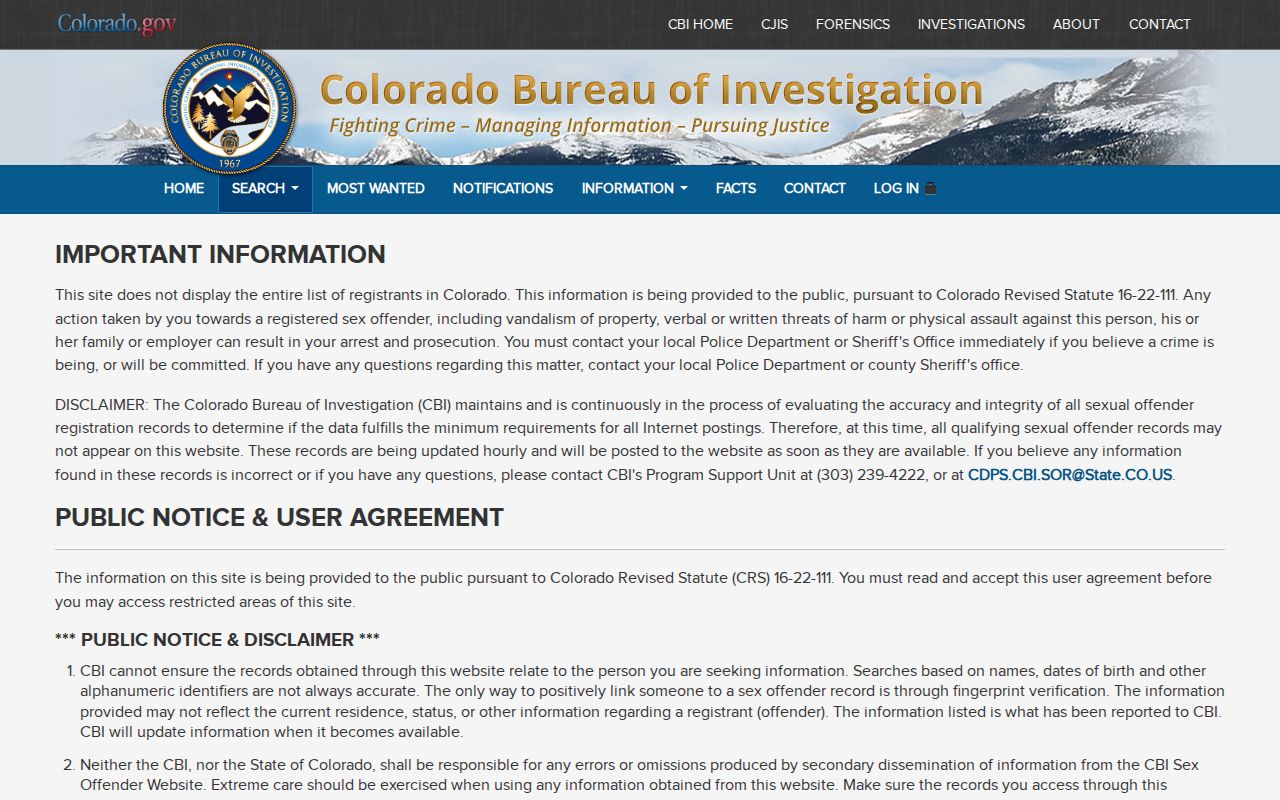
A registry result is not positive identification or a complete resident record. The El Paso jail roster and Colorado DOC search have the same snapshot and scope limits.
Lawful personal use. Use Colorado Springs records for a lawful property, court, civic, genealogy, family, or personal-safety question. Repeated monitoring, threats, intimidation, stalking, or harassment can violate C.R.S. sections 18-3-602 and 18-9-111. Verify a disputed result with the custodian and stop when a record is protected or does not establish the person.
A person search should stop at the boundary, not push past it. A non-owner occupant, protected voter, sealed court party, ineligible vital-record requester, unlisted business contact, or someone outside the county may simply produce no public match. A missing result is not proof the person is absent from the residents directory. It just means the right custodian holds the record, or the record stays closed.