
Colorado Springs City Directory Collections
The Pikes Peak Library District anchors the local shelf. Its Regional History & Genealogy collection holds Colorado Springs city directories from 1879 to the present, while a digitized local run from 1879-1929 is online with gaps. The volumes cover Colorado Springs, Colorado City, now Old Colorado City, and Manitou Springs. Many volumes after 1900 add a street cross-reference, so a known address can lead to a name as well as a name leading to an address.
Different holdings answer different historical questions. Colorado College preserves a 1901 telephone directory record and Giles material for the same regional places. Newspapers, Sanborn maps, museum archives, and State Archives guides can test a date or place when a directory entry is brief. The table separates the main directory shelf from those useful companion collections.
| Collection | Years | Where Held | Access |
|---|---|---|---|
| PPLD Colorado Springs directories | 1879-present collection; digitized 1879-1929 with gaps | Regional History & Genealogy and PPLD Digital Collections | Walk-in room and online PDFs; street cross-reference often after 1900 |
| PPLD volume examples | 1879, 1888, 1903, 1904, 1907, 1916, 1922 | PPLD Digital Collections and the 1904 PDF | Browse or read online; confirm gaps by volume |
| Giles and telephone directories | April 15, 1901 record; Colorado Springs, Colorado City, and Manitou | Colorado College Tutt and digitalCC | Digital metadata and special collections research |
| Gazette newspaper holdings | Weekly 1873-1906 and 1924-1942; daily February 1877-1946; Gazette-Telegraph 1946-1970 | Colorado College and PPLD resources | Microfilm or database access; title changes and gaps matter |
| Historical companions | Sanborn 1883-about 1960; State Archives collections are set-specific | Library of Congress, PPLD, CSPM, and Colorado State Archives | Use for context and cross-checking, not as a resident roll |
The first row describes the shelf, not a complete annual sequence. A missing year is a reason to switch to another volume, ask staff about an unscanned copy, or pair the nearest available year with a newspaper or census record.
Colorado Springs Digitized City Directories
The PPLD house-history guide puts the directory shelf beside permits, water taps, newspapers, maps, and street-name cautions. Its dates make the online run useful without making it look complete. The named examples include 1879, 1888, 1903, 1904, 1907, 1916, and 1922. Each year should be checked on its own because the digitized sequence has gaps.
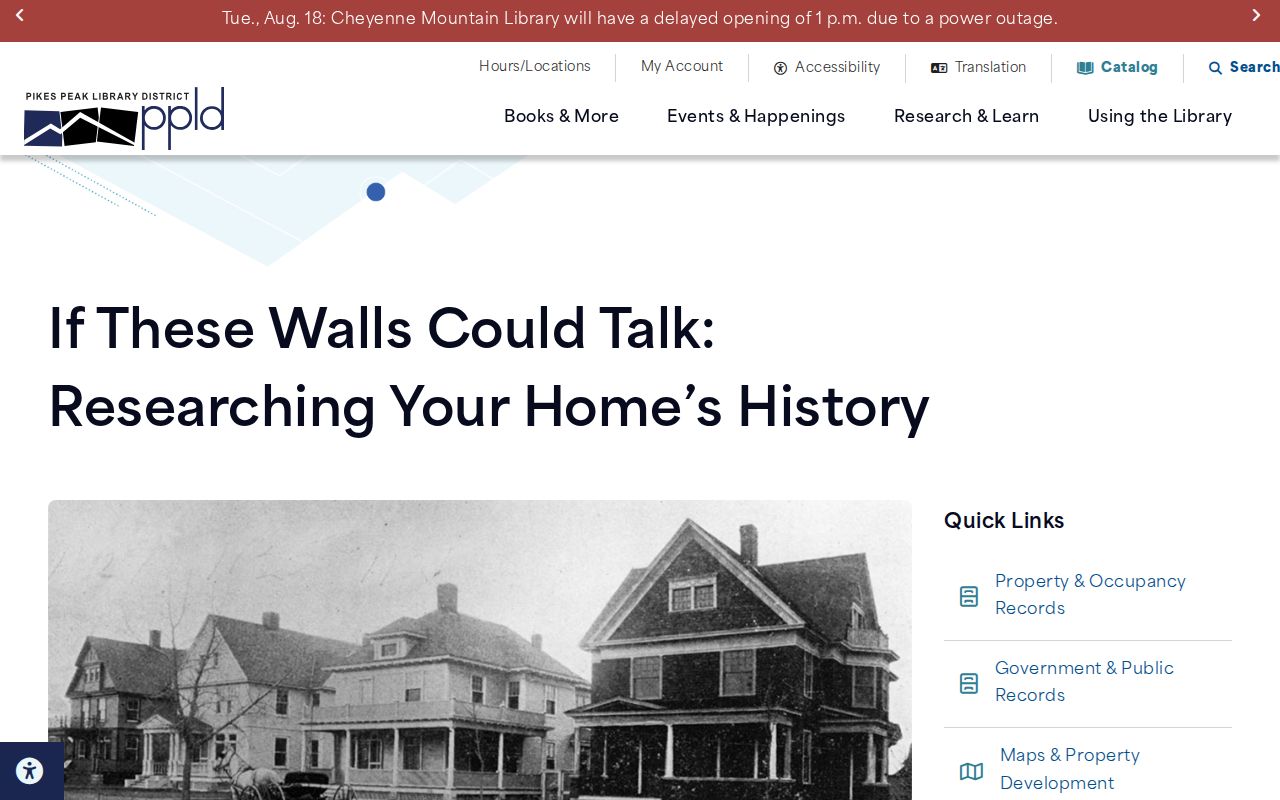
The guide links a researcher to the local method: start with a name or address, note the old place label, then compare the street guide with the alphabetical section. That process is valuable in Old Colorado City, where street names and house numbers changed across the older city and annexation period.
The PPLD Digital Collections search can be narrowed by item type. Choose City Directory when the goal is a directory volume, then try Map, Photograph, Newspaper Article, or genealogical records for a second clue. The digital collections search tips help separate a broad surname hit from a page that carries the right date and place.
Colorado Springs Records and the 1903 Courthouse
The 1903 El Paso County Courthouse is part of the local records story. The building held four courtrooms plus offices for the Sheriff, Treasurer, Clerk, and Surveyor. County work later outgrew the structure. A demolition plan supported in 1966 was stopped by a preservation campaign, and the building became the Colorado Springs Pioneers Museum in 1979 after National Register recognition in 1972.
That change gives historical research a useful physical connection. The CSPM Starsmore archives now hold manuscripts, photographs, ephemera, maps, blueprints, and a non-circulating reference library for the Pikes Peak region. A directory name can therefore lead into a building file, map, or local story without treating the museum collection as a complete name index.
Reading a Colorado Springs City Directory Entry
A directory entry is a historical snapshot. It may describe a person in a role, a household relationship, a street address, or a business listing, but it is not a government-certified residence record. Read the introduction and nearby entries before expanding an abbreviation or treating a mark as proof of a present-day fact.
| Name | Surname and given name, often with initials or a spelling that needs comparison across years. |
|---|---|
| Occupation or role | A historical occupation or business role, sometimes tied to the classified section. |
| Spouse or relationship | Parenthetical relationship notes may identify a spouse or another household link. |
| Street address | House number and street, with old names or number changes needing a cross-check. |
| Householder placement | The alphabetical line may connect to a householders-by-street page for address order. |
| Notation and status clues | Widow or widower wording, boarding-house language, abbreviations, and initials need context. |
Several terms describe how the pages work:
- Criss-cross directory
- A reverse street tool inside many local volumes after 1900. A separate bound criss-cross series with its own publisher and exact years was not verified, so confirm any claim with staff.
- Householder index
- The householder-by-street arrangement that groups names by address order and supports a street-first search.
- Abbreviation key
- The volume's introductory aid for short forms, initials, and marks. Read it before interpreting a line.
- Historical snapshot
- A dated record of what the publisher recorded, not proof that every person at an address was listed.
When a line seems unclear, compare the same surname in the alphabetical section, the street section, a nearby year, and a local newspaper. Small differences can reflect a move, a new household head, or a change in how the publisher recorded the entry.
The 1904 Colorado Springs Directory Layout
The 1904 Colorado Springs directory PDF shows why one volume can support several kinds of research. Its front matter includes historical and miscellaneous material, followed by a street guide, an alphabetical directory, a classified business section, and householders arranged by streets. The street pages are the key reverse path for a known block or house number.
The front matter reports approximately 14,947 Colorado Springs names or entries. That is an entry count, not a population count and not a current resident total. The volume also says homes and businesses were visited, which describes the publisher's process for that edition. The count should be cited with the year and the word “entries,” never converted into a claim about how many people lived in the city.
Colorado College's 1901 Colorado Springs Directory
The digitalCC record for the 1901 Colorado Springs Telephone Directory is dated April 15, 1901. Its metadata identifies Giles directories for Colorado Springs, Colorado City, and Manitou, and lists call number Ms0349 Fd154. That record adds a telephone-history layer to the household and business material found in the PPLD shelf.
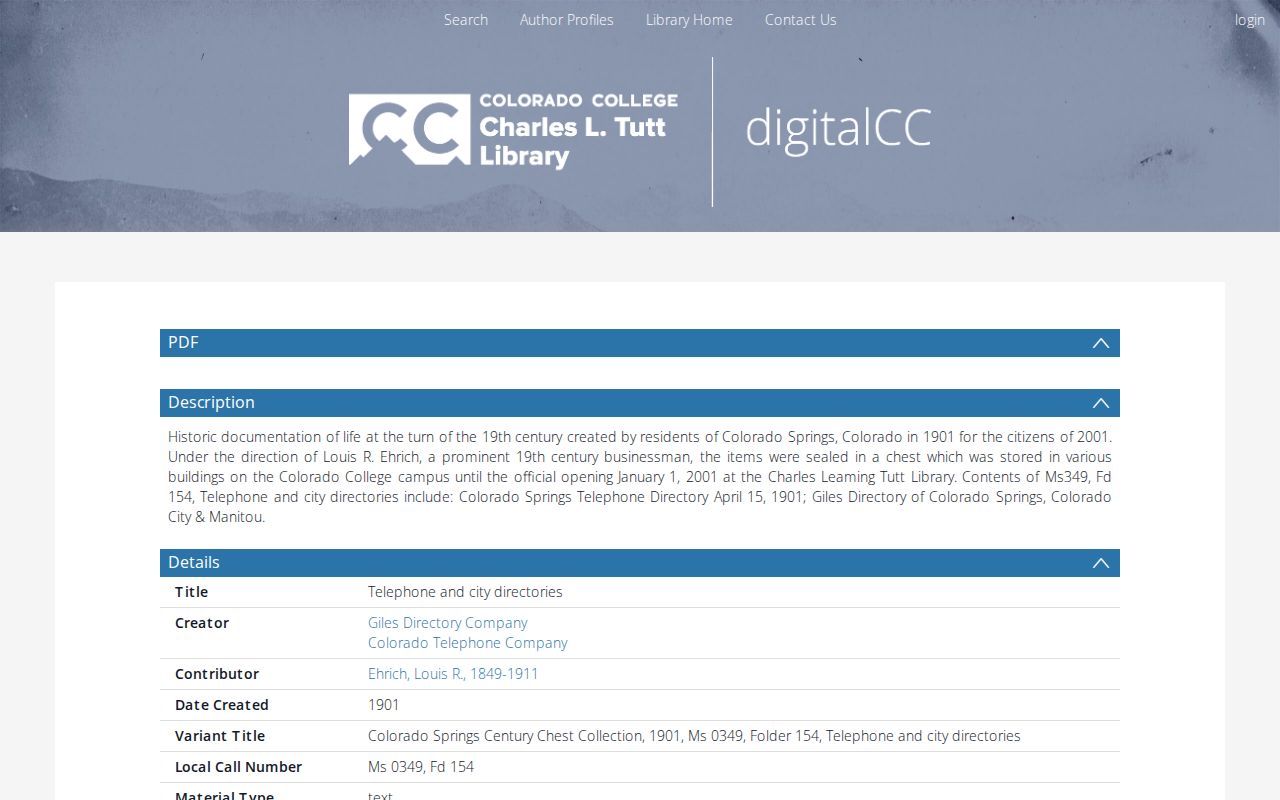
The Tutt Library Special Collections research route is at 1021 N. Cascade Avenue. The listed contact is 719-389-6668 and tuttspec@ColoradoCollege.edu, with weekday research hours that include a midday closure. A visit or inquiry can clarify what the physical record contains beyond the digital metadata.
The telephone volume should be read as a dated regional source. It can connect a name to a listed number or business context for that year, but it does not establish a current phone number or present residence.
Trace Colorado Springs Directories for Family History
Tracing works best when each directory year is treated as one point in a longer household timeline. Record the exact spelling, initials, role, relationship note, street number, street name, and source year. Keep Colorado Springs separate from Colorado City or Manitou until the address and place labels are reconciled.
Use the following order for a name, address, or family clue:
- Choose the nearest available volume and search the alphabetical section for the name or business role.
- Copy the full line, including address, spouse or relationship note, abbreviations, and any householder reference.
- For a post-1900 volume, use the street cross-reference or householders-by-street pages to test the address and nearby entries.
- Pair the directory with a federal census year. Census images from 1790-1950 are public under the 72-year rule; the 1960 census is scheduled for release in 2032.
- Close a gap with a newspaper, obituary, cemetery entry, probate file, map, or archive contact, and cite the exact source year.
A name that disappears may signal a move, death, a new household head, an unlisted person, or a missing volume. A census page can show household members that a directory did not list, while a newspaper can supply the date of a move or death. Treat absence as a question to test, not a conclusion.
Note: Pairing nearby years makes a stronger family-history trail than relying on one directory line or one spelling.
Colorado Springs History Rooms for Directory Research
The PPLD Regional History & Genealogy room is connected to the historic 1905 Carnegie Library and the Penrose Library downtown. Its scope includes books, maps, manuscripts, archives, photographs, oral histories, films and video, government documents, pamphlets, and periodicals. Walk-ins are welcome for ordinary use; archival pulls should be arranged through 719-531-6333 ext. 7252 or RegionalHistoryGenealogy@ppld.org.
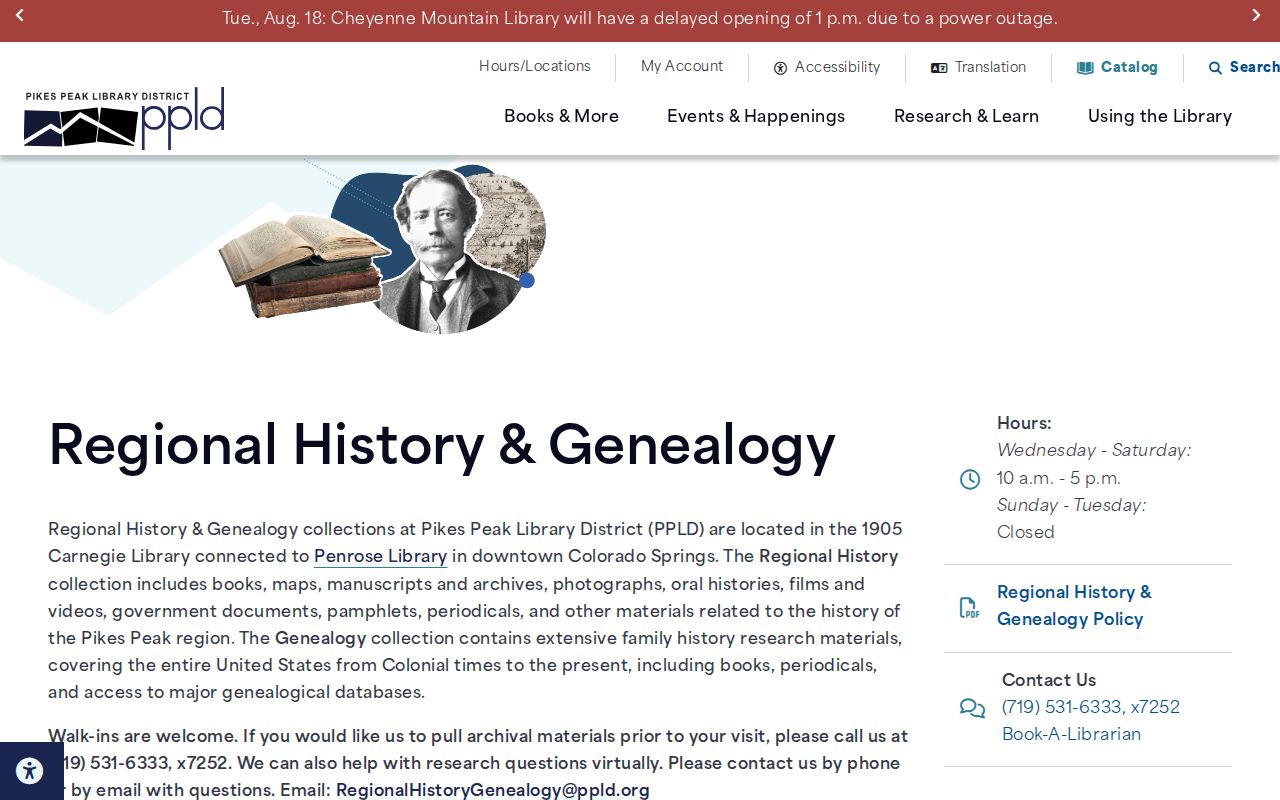
Posted research hours are Wednesday through Saturday, 10:00 a.m. to 5:00 p.m. Staff assistance matters when a volume is not digitized, a street name has changed, or a water-tapping or permit record must be pulled from a partial series. PPLD's local shelf is broader than a name search because it joins a directory with maps, newspapers, and house-history material.
The Starsmore Center for Local History at CSPM offers another appointment route. Its archives hold manuscripts, photographs, ephemera, maps, blueprints, and a non-circulating reference library. Research appointments are Tuesday through Saturday, 1:00-4:00 p.m.; Hillary Mannion is listed at 719-385-5650 and Hillary.Mannion@coloradosprings.gov, 215 S. Tejon Street.
Colorado Springs Directories, Census, and Maps
A directory becomes more useful when the address is checked against a second record family. Federal census pages can test household size and timing. The Library of Congress Sanborn map collection includes local coverage from 1883 to about 1960, with the largest local set around 1907. A sheet can show a building footprint, use, material, outbuildings, lot context, and sometimes a house number, but it cannot prove who lived there.
PPLD also identifies partial water-tapping records from 1902-1940 arranged by street in El Paso County permit records. Those records can add a connection or building clue when a directory is silent. Newspapers supply another date check. The Colorado College newspaper holdings list the Colorado Springs Weekly Gazette for 1873-1906 and 1924-1942, the daily Gazette from February 1877-1946, and Gazette-Telegraph from 1946-1970, with later runs, title changes, and gaps.
The Colorado State Archives guide is a historical adjunct, not a complete El Paso County name index. Its guides identify an El Paso naturalization index from 1869-1970, declarations from 1879-1969, final documents from 1880-1970, probate from 1922-1976, fragmentary marriage material from the 1860s-1932, district divorce from 1870-1961 and 1979-1984, and county divorce from 1867-1965.
The archives image points to a guide and request path, not a promise that every case or person appears online. Date the directory entry, preserve the old place name, and ask the archive or library about the next record when the trail crosses from a printed volume into a county or state collection.