
Colorado Springs Sources for Previous Residents
A one-address history changes source as the years change. Start with the current parcel and recorded transfer trail, then shift to directories, maps, permits, newspapers, census schedules, and court or archive files. The El Paso County recorder is strongest for recorded instruments. The library and university collections are stronger for household names and old street forms. A permit can date work on a building, while a Sanborn sheet can show its footprint and use. The table keeps those roles separate so a property fact is not mistaken for proof that a person lived there.
| Source | Years It Covers | Where Held | What It Shows |
|---|---|---|---|
| Recorder real-estate index | Permanent index 1980-current; images observed 1980-current; routine remote images 1996-current | El Paso County Clerk and Recorder | Deeds, liens, plats, mortgages, parties, and recording dates; older images are being imported |
| Assessor parcel record | Current parcel and tax roll; historical span varies | El Paso County Assessor and Spatialest | Owner, mailing address, situs, legal description, values, and building details; not every household member |
| Colorado Springs city directories | 1879-present collection; digitized local run 1879-1929 with gaps | PPLD; Colorado College metadata | Names, occupations, addresses, street cross-references, and householders |
| Building permits | March 1900 forward; gap April 1902-September 1907; county permits 1954-1964 | PPLD and PPRBD | Owner or contractor, project type, cost, inspection, and construction clues |
| Water-tapping records | Partial 1902-1940 | El Paso County permit records through PPLD | Street-arranged connection and dating clues; incomplete |
| Sanborn maps | 1883-about 1960; largest local set about 1907 | Library of Congress and PPLD | Building footprints, materials, use, outbuildings, and lot context |
| Federal census | 1790-1950 public under the 72-year rule; 1960 scheduled for 2032 | NARA, Census, and library databases | Household snapshot at an enumeration date, with boundary and coverage limits |
| Newspapers and obituaries | Gazette family 1873-present with title changes and gaps | Colorado College and PPLD | Death notices, address clues, social notices, and property stories |
| Probate and related court files | El Paso probate 1922-1976; divorce holdings are collection-specific | State Archives and Fourth Judicial District | Heirs, estates, and legal relationships; restrictions and incomplete indexes apply |
For a recent transfer, begin with the assessor and recorder. For a house occupied before the recorder trail becomes useful, begin with the PPLD directory shelf and street guide. A person named in a directory is a household clue, not a certified occupancy result. Dates should be paired across at least two source types before a past resident is placed in a timeline.
Freeze a Colorado Springs Address First
Write down the address exactly as it appears now, including directional words, street type, unit information, city, state, and ZIP. Then open the El Paso County Spatialest property search and test the address. The assessor form also accepts an owner name or schedule and parcel number. Its card can show Owner, Mailing Address, Location, legal description, parcel or schedule number, values, building details, sales history, and deed or sketch links.
Keep the situs or Location field apart from Mailing Address. A tax notice may go to a bank, trust, representative, former address, or an address outside Colorado Springs. It is a useful lead, not a statement that the named person occupies the parcel. Save the parcel number and legal description before searching backward. The legal description, such as a lot and block or a metes-and-bounds description, is more stable than a street number when names and addresses change.
Use SpringsView to place the address on the city map. If the point is outside the city layer or the map result is unclear, check the El Paso County parcel service. Preserve the source and the date you checked it. A map confirms a parcel relationship and jurisdiction; it does not create a list of every person at the address.
The El Paso County Assessor office is at 1675 W. Garden of the Gods Road, Suite 2300, and lists 719-520-6600 for assistance, Monday through Friday from 8:00 a.m. to 4:30 p.m. Routine property information is public, so the office is a useful fallback when a portal result needs clarification.
Colorado Springs Recorder Coverage Changes
The El Paso County Real Estate Index has a permanent index observed from January 1, 1980 through the prior day, plus a temporary current-day index. Images were observed from January 1, 1980. Routine remote image access is described as 1996 to the present, while older back-images are being imported over time. The index is free to search. Image access can require the remote service or a copy request, so an index row and a readable deed image are separate steps.
Do not turn those dates into an exact pre-1980 cutoff. The reviewed county material does not publish a definitive online cutoff or a complete microfilm series for earlier deeds. For an older instrument, ask the Citizens Service Center about paper books, microfilm if available, or a copy route. The recorder does not perform a title search for a requester. A careful researcher can build a documentary chain, but a legal title opinion belongs to a title professional.
The county’s recorded-document route also serves people who cannot use the portal. The main office is the Citizens Service Center at 1675 W. Garden of the Gods Road in Colorado Springs, with the recording department at 719-520-6200. Copy requests go to copyrequests@elpasoco.com or 877-487-2778, and the county says email requests are answered within 48 hours when possible. Pre-1996 copies must be handled at the Citizens Service Center.
The recorder index search form is useful even before a result is found because its fields reveal how the county keys a document trail.
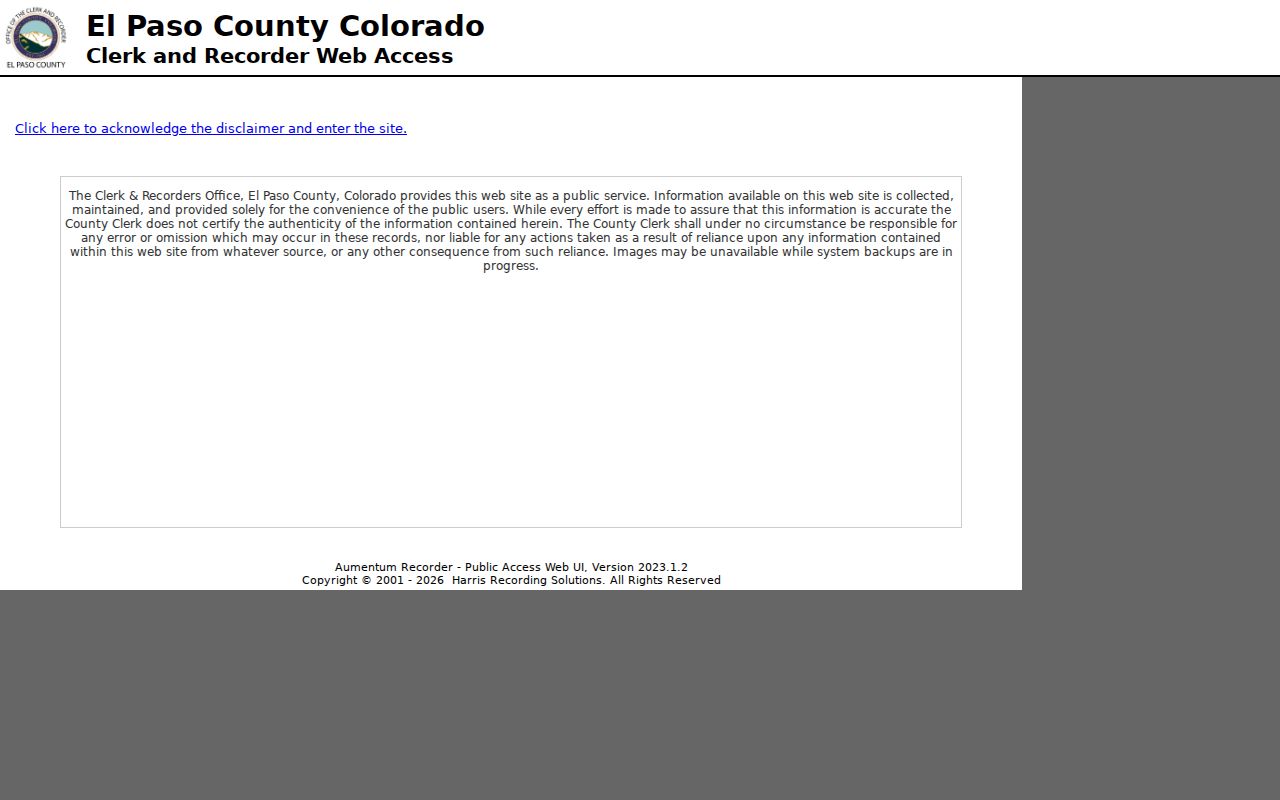
The captured form emphasizes parties, dates, instruments, document types, subdivisions, condominiums, and land descriptions. Those keys help connect a current parcel to an older recorded transfer.
Note: The county has not published a definitive pre-1980 online deed cutoff in the reviewed material, so older coverage must be checked with the custodian.
Colorado Springs Directory and Census Layers
Ownership tells only one part of a house story. PPLD’s house-history guide identifies Colorado Springs city directories from 1879 to the present in the Regional History and Genealogy collection, with digitized local volumes from 1879 to 1929 and gaps. Many volumes after 1900 include a street cross-reference. The 1904 volume has a street guide, alphabetical entries, a classified section, and householders arranged by streets. Its front matter reports about 14,947 names or entries, which is a directory count, not a population count.
The guide is a practical bridge from a deed date to a household clue. Use a street page to see which names were attached to the address, then check the alphabetical section for occupation, spouse or relationship notation, and address spelling. Read the introduction for abbreviations. A directory may omit a household, list a boarder in a different way, or preserve a name after a move. The broader Colorado Springs city directory collection has the detailed shelf and entry-reading context.
The PPLD house-history guide image shows why several source types belong in the same search. It places directories beside permits, assessor history, Sanborn maps, water taps, maps, and newspapers.
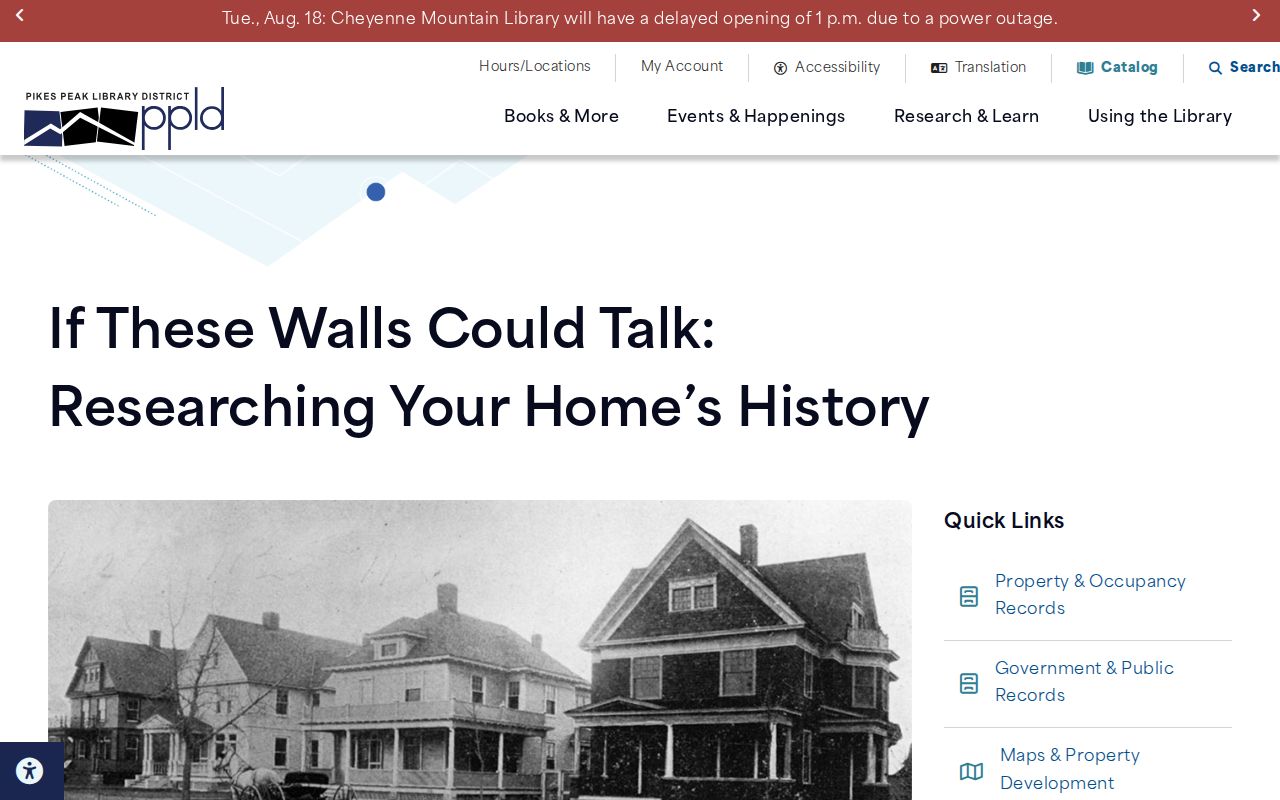
That combination helps test whether a name, a building, and an address line up in the same period. It also makes gaps visible instead of hiding them behind a single search result.
Colorado College adds a separate historical route. Its digitalCC record for the 1901 directory identifies a Colorado Springs Telephone Directory dated April 15, 1901, along with Giles directory metadata for Colorado Springs, Colorado City, and Manitou Springs.
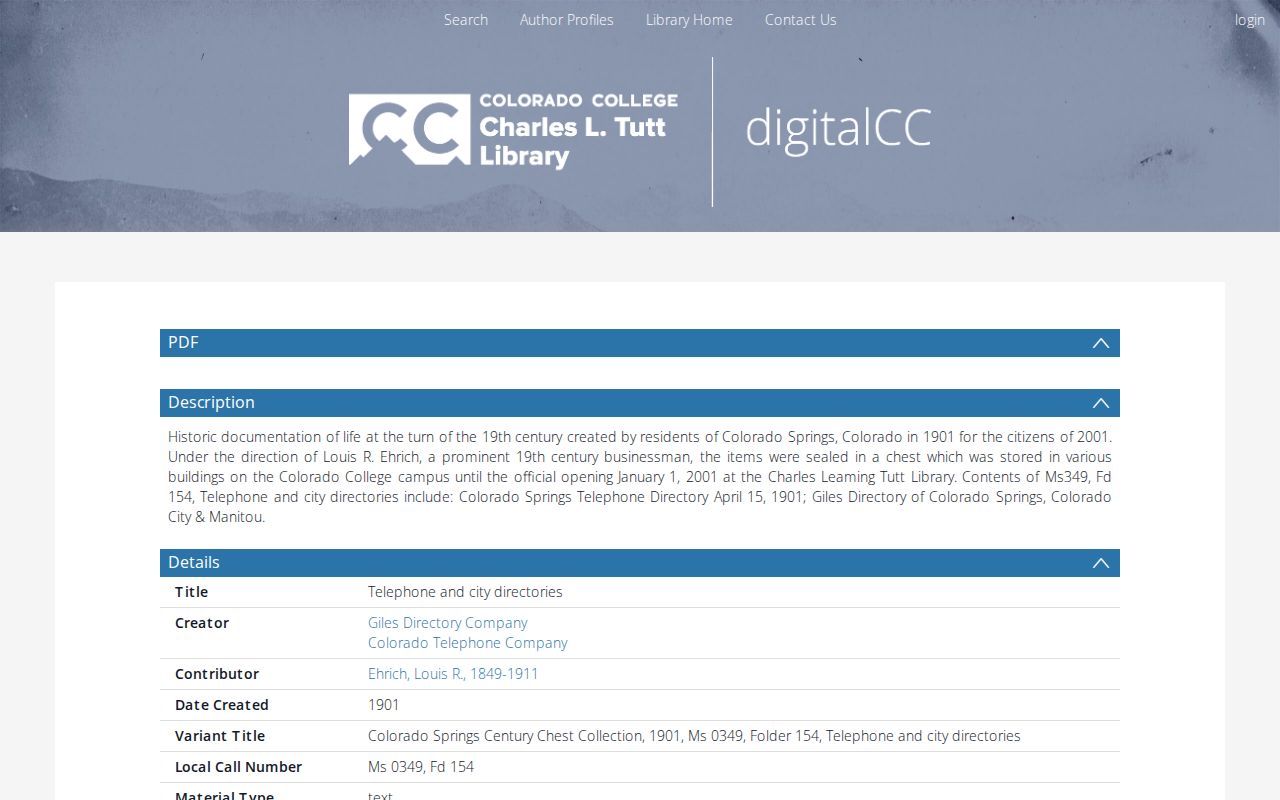
The university record is metadata and collection guidance, not a current resident result. It can preserve a place name or directory year that helps match a historic address to the right local volume.
Colorado Springs Deed Chain for Past Owners
Once the assessor card is frozen, move from the current owner to the likely purchase deed. The recorder index is party- and instrument-keyed, so an address alone is not enough. Search the current owner as a grantee, use a reasonable date range, and prefer a deed type that fits a transfer. Read the likely record for the seller, recording date, instrument number, book and page, image status, and the same legal description saved from the assessor.
- Record the current owner, parcel or schedule number, situs address, mailing address, and legal description from Spatialest.
- Search the owner in the recorder index as Party Type Grantee, then narrow by date and deed type when the result set is broad.
- Open or request the likely purchase record and copy the grantor, grantee, recording date, instrument number, book and page, and legal description.
- Search the seller as a prior grantee. Confirm the same lot, block, subdivision, condominium unit, or metes-and-bounds description before accepting the match.
- Repeat the seller-to-prior-seller search until the available index or image route ends, then move to the counter, copy request, library, or archive channel.
- Grantor and grantee
- The grantor is the party giving or transferring an interest. The grantee is the party receiving it in the recorded instrument.
- Chain of title
- A linked sequence of recorded ownership transfers for the same parcel, checked from one deed to the next.
- Legal description
- The formal land description used in a deed or plat. It can identify the parcel when a street name or number has changed.
A deed of trust is financing evidence, not automatically an ownership transfer. Liens, releases, assignments, easements, covenants, annexation records, and public-trustee documents may explain the record trail, but they should not be labeled as a sale without reading the document type and parties.
Colorado Springs Recorder Search Fields
The real-estate form supports more than a name box. Use the simplest key first, then add a legal or document filter when a common surname produces too many rows. Grantor and grantee roles matter because the seller in one deed may be the earlier buyer in the next. A date range keeps the trail tied to the transfer period instead of every filing for a person.
| Field | How it helps a previous-resident search |
|---|---|
| Search mode | Use a combined party search or separate Grantor and Grantee names. |
| Party Name and Party Type | Test an owner or seller spelling, then choose Grantor, Grantee, or both. |
| Role | Separate roles such as trustee, executor, estate, successor, or agent from the main party name. |
| Date Filed From and To | Match the likely acquisition period and use the form’s date format or quick ranges. |
| Instrument Number and Book/Page | Use a known recording key to return to one document or request a copy. |
| Document Type | Narrow to Warranty Deed, Quit Claim Deed, Deed-Other, Public Trustee Deed, or another recorded type. |
| Subdivision or Condominium | Use name, lot, block, phase, building, or unit fields when the address is unclear. |
| Section Land | Test section, range, township, survey name, or freeform legal-description clues. |
Search results may expose a party, document type, recording date, book and page, instrument number, and an image or copy path. The free index is a finding aid. If an image is not available remotely, use the county office or copy route rather than filling the gap with an assumption. Names can change through marriage, initials, estates, trusts, and business styling, so the legal description is the main check.
Colorado Springs Address Changes Over Time
Old Colorado City and the Westside create a special trap for previous-resident research. PPLD reports repeated street-name and house-number changes from the 1870s through 1917, including places where odd and even numbering flipped. Colorado City was annexed to Colorado Springs in 1917, and the city expanded west in 1890. An older directory may therefore name Colorado City, use a former street name, or show a number that does not land on the current parcel.
When a 1904 household entry seems to vanish, compare its street guide, neighboring entries, recorded plat, legal description, and a Sanborn sheet. Check the annexation history before deciding that the building or household moved. A historic place label is evidence about the record’s setting, not a modern legal boundary. Preserve the old form beside the normalized address so a later researcher can repeat the match.
Note: A street-guide match is a lead, not proof that a historic number maps to the same modern parcel.
Colorado Springs Archive Routes for Older Deeds
When the online recorder does not answer the question, use the local record keepers in layers. The PPLD Regional History and Genealogy room welcomes walk-ins Wednesday through Saturday from 10:00 a.m. to 5:00 p.m. Archive pulls can be arranged through 719-531-6333 ext. 7252. Staff can point a researcher to directories, maps, newspapers, permits, water taps, and local genealogy material.
Colorado College Tutt Special Collections holds the 1901 directory metadata and physical materials that can add a campus, telephone, neighborhood, or institutional clue. For older probate, marriage, divorce, death, or naturalization material, use the Fourth Judicial District records route or the Colorado State Archives guides, and check each collection’s access rules. El Paso probate holdings run from 1922 to 1976. District and county divorce holdings are collection-specific, and named indexes may be incomplete.
The 1903 El Paso County Courthouse once held four courtrooms and offices for the Sheriff, Treasurer, Clerk, and Surveyor. County operations later outgrew the building. A preservation fight followed demolition support in 1966, and the former courthouse became the Colorado Springs Pioneers Museum in 1979. That handoff gives a house-history search a local records story: a modern request can lead to maps, blueprints, and archives kept in the city’s former civic record center.
The State Archives research route image reflects the need to check a guide before assuming that an old county record is open or online.
Archive staff, library staff, and a courthouse records clerk can explain the right request path. They cannot turn a restricted record into an open name list, and they may need a case number, date range, party name, or collection reference.
Colorado Springs Building and Water Clues
Permits can anchor a house history when the deed chain is clear but the building’s age is not. The Pikes Peak Regional Building Department advanced search accepts address, parcel, permit, plan, jurisdiction, project type, issued-date range, status, discipline, description, valuation, and five-digit ZIP fields. It can return construction, mechanical, electrical, plumbing, sign, elevator, manufactured-home, or wrecking records, plus project and plan-card links. A permit applicant or contractor is connected to work on the property, not automatically to residence.
PPLD identifies city building permits from March 1900 forward, with a gap from April 1902 through September 1907, and county permits from 1954 to 1964. Partial water-tapping records from 1902 to 1940 are arranged by street and can date a connection when a deed or permit is silent. Ask library staff for those records because the series is incomplete.
Sanborn maps add the built setting. Local sheets run from 1883 to about 1960, with the largest local set around 1907. The Library of Congress Sanborn collection has digital sheets where available, while PPLD holds local originals and oversized material. A Sanborn sheet can show footprints, materials, use, outbuildings, and lot context. It cannot prove which past residents occupied the building.
Colorado Springs Previous Residents in Household Records
Past households require a different test from past owners. Pick a directory year close to the deed or permit date, read the street section, and then check the name section. Pair that result with a public census year, but remember that a directory householder is not the same as every census household member. Census images from 1790 through 1950 are public under the 72-year rule, while the 1960 census is scheduled for release in 2032.
- Choose the nearest useful Colorado Springs directory year and copy the street form, number, name, and any householder or relationship notation.
- Check the alphabetical entry for occupation, spouse notation, initials, abbreviations, and a second address clue.
- Pair the directory date with the nearest public census schedule and record the enumeration district or boundary context.
- Search Gazette holdings or PPLD newspaper databases for an obituary, social notice, property story, or later address, checking title changes and coverage gaps.
- Use cemetery or probate records as an endpoint or relationship check, not as automatic proof of residence at the target address.
The Gazette family has title changes and gaps, so search more than one title form when a date is known. An obituary may connect a name to a family, estate, or later address, but it may not state the person’s full residence history. El Paso probate material at the State Archives can add heirs, executor names, and estate addresses for the years held. A district or county divorce file may be relevant to a family timeline, subject to its access rules.
Lawful use. Colorado Springs previous-resident research belongs in lawful house history, family history, genealogy, civic research, or personal-safety work. Colorado law prohibits stalking and harassment, and public availability does not permit threats, repeated monitoring, or publication of protected addresses.